Table of Contents
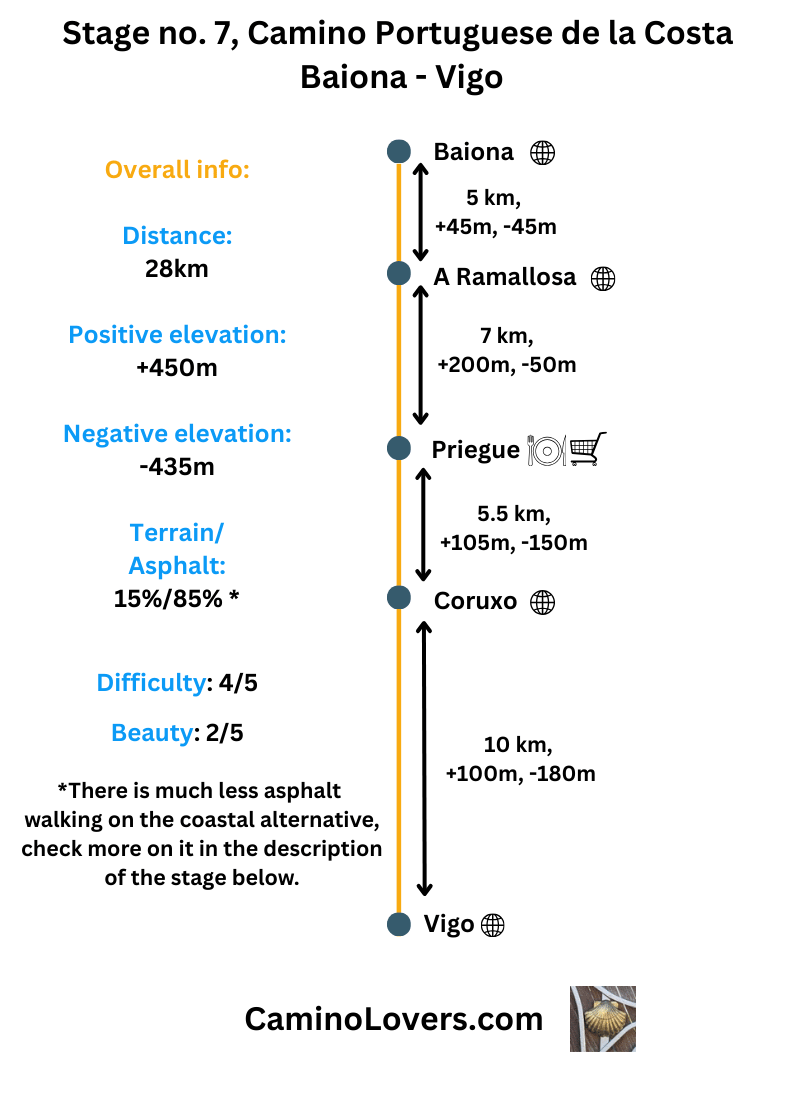
Basic Information
- Starting Point: Baiona, Spain – A lively coastal town with a rich maritime history, famous for being the first place in Europe to receive news of the discovery of America. With around 12,000 inhabitants, Baiona is very welcoming to pilgrims and offers everything a pilgrim may need, not only for one afternoon in town.
- Ending Point: Vigo, Spain – The largest city in Galicia, with roughly 300,000 inhabitants, and an important industrial and port center. As in every big city, you’ll find in Vigo numerous hostels, hotels, restaurants, cafés, supermarkets, pharmacies, hospitals, and public transport connections. The entrance into the city is more urban and can feel endless, but that’s how it is with every truly big city on the camino… In any case, there’s one big pilgrim only hostel, with almost 100 beds, and also a couple of affordable hostels. It isn’t a bad place for one night on the way.
- Availability of an alternative route: YES, there is an alternative route following the coast, just as it is the case with most stages. It is marked with sparse green and yellow arrows, and passes through some relatively nice beaches, very frequented (and overcrowded) in summer months (due to the proximity of big towns). It is roughly 1.5 km shorter than the official camino and has less elevation. However, the terrain is more difficult than the one on the official camino route. You also miss several nice spots that you pass by following the official camino. To sum it up, I wouldn’t specifically recommend one route over another in this case. The choice depends on your preferences.
- Maps:
- Distance:
- Elevation Difference:
- Official Camino: +450m, -440m
- Alternative coastal route: +190m, – 180m
- Difficulty Score:
- Official Camino: 3/5.
- Coastal alternative: 3/5.
- Beauty Score: 2/5, for both ways. Just as one can expect from the entrance into the big city.
- Terrain/Asphalt Walking Ratio:
- Official camino route: 15%/85%.
- Alternative route: 35%/65%.
- Next stage: Camino Portuguese de la Costa, Stage no. 8, Vigo – Arcade.
- Previous stage: Camino Portuguese de la Costa, Stage no. 6, Oia – Baiona.
Elevation profiles for the routes
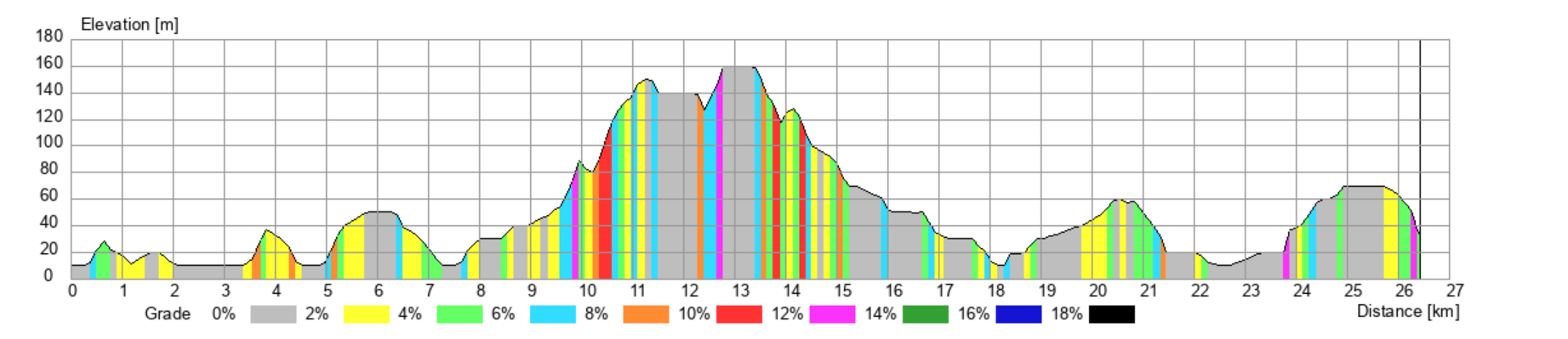
– Official camino, the stage is quite eventful, with many hills. However, except of a few short sections with climb gradient of 10% and more in the middle of the stage, the hills are not steep, and the terrain does not present any technical challenges.
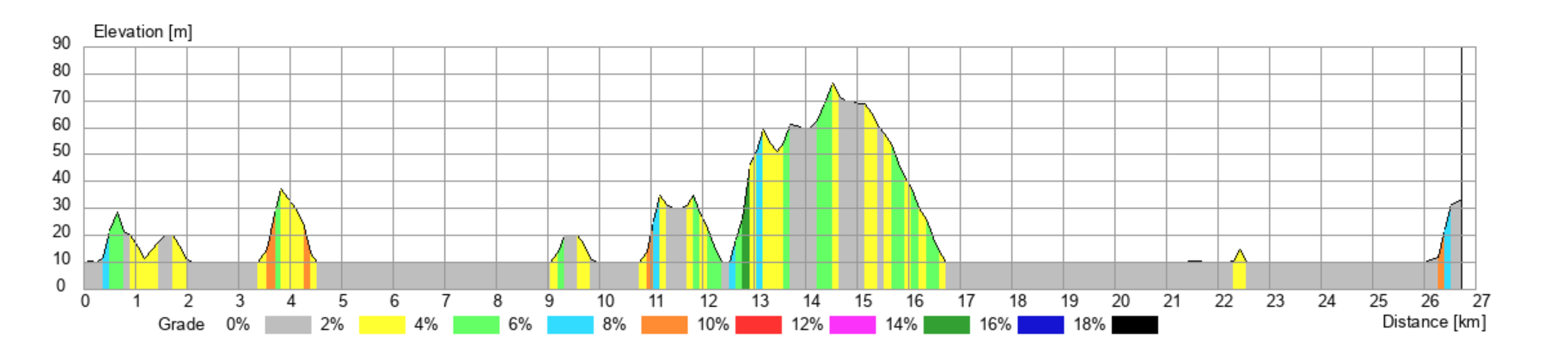
– Coastal alternative, much flatter than the official camino. The last 10 km are super flat, but you’ll have a few short hills in the middle of the stage.

Advanced info about the stage
- Natural Highlights:
- Montefero, 1.5 km detour from the camino, exactly here. It is a rocky peninsula covered with pine trees that extends into the Ría de Vigo. From the various viewpoints you can see the Cíes Islands, and the beaches of Praia América and Panxón. The cliffs on the western side are quite dramatic, with waves crashing into granite rock formations. Obviously the cliffs aren’t as beautiful as cliffs on Camino del Norte, but they are some of the best cliffs you can see on this entire Camino Portuguese.
- A beautiful waterfall, basically right on the Camino, exactly here. The little detour is signposted. Obviously it is best in spring months, but worth a short stop in every season of the year. A decently preserved watermill nearby as well.
- Historical & Cultural Highlights:
- The bridge of Ramallosa, right on the camino, location on Google maps here. Built around the 13th century (possibly on Roman foundations), Constructed to allow pilgrims to cross the Miñor River, it was an important crossing point on the Camino Portugués da Costa for pilgrims traveling towards Santiago de Compostela, back in the centuries when there were even more pilgrims that there are today :). Next to the bridge once stood the Hospital de Peregrinos de A Ramallosa, run by a religious brotherhood, which provided food, shelter, and medical care for pilgrims on their often very strenuous way towards Santiago.
- Castello de Castro, Vigo. Location on Google maps here. While Vigo is more an industrial and port center than a city to go to do sightseeing, there are some nice spots in town. For example this 17th century fortress, built to defend Vigo from attacks during the wars with England and Portugal. The stone walls and the canyons are well-preserved, and, since it is on the hill, there’s a beautiful view from the fort as well. Free entry.
- Parque de Castrelos, Vigo, location on Google maps here. This park is a combination of natural and historic highlights. Not only it is the most beautiful park in Vigo, and big enough to spend couple of hours walking through its many paths on your camino afternoon, but there is a Baroque palace turned into an archeology and art museum, and several beautiful statues, some of them dating back centuries… If you’re into beautiful parks, you should not miss this one on your afternoon in Vigo :).
- Alternative route info: For the first 7 km, the alternative coastal route is identical with the official camino. Then, once you cross the bridge in Ramallosa, exactly here, you turn left instead of continuing straight. When I walked this way there wasn’t any sign, but I heard there is one now. In any case, you turn left, and basically stay close to the coast all the way to Vigo, always having the ocean on your left. The way passes along some decent beaches, such as Praia America (very highly rated beach), or Praia de Patos, super crowded in summer… While this route has less asphalt walking, it is still pretty urban and crowded, and I do not necessarily recommend it. It is marked with both yellow arrows and green marks, on some sections the marking is better on some worse. But there’s really no way of getting lost here…
- Camping/Bivouac Options on the Stage: As you can likely imagine, in this highly urban zone, it is extremely tricky finding a good camping spot. Sure, in Vigo you’ll find some abandoned bridges and buildings and that kind of stuff, but as in every big city in Spain, there’s where local homeless people sleep, and also where the local drug scene takes place… basically locations you should avoid as a pilgrim. Vigo and neighboring locations simply aren’t good for wild camping or bivouacking… There is one official camp site on this stage, roughly in the middle:
- Camping de Canido, location and reviews on Google maps here. Right on the coastal alternative, 2 km detour from the official camino. A simple oldish kind of camping, with clean yet dated installations. Price: 16 euro/night for a one person in a tent with electricity (11 without electricity). Dog friendly with decent beach nearby. Nice location, and while the installations are quite old, I still feel it is a good value for the price.
- Dog-Friendly Score: 2/5. Overall very bad for dogs. Lot of asphalt walking, urban spaces, lot of noise, hard to find affordable accommodation. Walking with a dog, make sure to follow the alternative route. While it is also pretty urban, you have at least a few green stretches and two good river crossings where your companion can cool down. There aren’t any dog friendly hostels or other cheap accommodation options in Vigo. However, you can try this pension (rooms from 40 euro/night) and this hotel (rooms from 45 euro/night), which are the 2 most affordable pet-friendly lodgings in Vigo. Of course it also always an option to skip the big city altogether with your dog 😉
- Special Remarks: In Vigo starts the last 100 kilometers of Camino Portuguese. It is a typical starting point for big organized camino tours, but also for large (and often also loud:)) groups of Spanish students, especially in July and August. You will notice a considerable growth of number of pilgrims, and also more pilgrim hostels (and other infrastructure) along the way. If you want to avoid the crowds, the best way to do so is starting early (early means 7am and before), following some alternative routes, and sleeping in places other than the most typical stops for big groups (Redondela, Pontevedra, Caldas de Reis, Padron).
My picks for accommodation on this stage
- Albergue San Xurxo, Saians, km 13. Location and reviews on Google maps here. A nice municipal albergue with 10 beds in one room, 14 euro/night. 1km outside of the Camino, but in a nice peaceful location. Decently equipped kitchen and the smaller number of beds, often create a nice bondage between pilgrims who cook together and spend time together in the evening. That’s very different to albergues with 20 or 30 beds, where such things simply won’t happen. Reservations on phone number +34 689 133 973, I recommend calling in advance because walking an extra kilometer from the coast and then not getting a bed would easily upset you :). Check-in from 3 pm.
- Albergue de Peregrinos de Vigo, Vigo, km 28. Location and reviews on Google maps here. As it is almost a norm on all caminos, finding a good accommodation for a pilgrim is most difficult in big cities. Vigo isn’t an exception, and this albergue has much to improve (non-existing kitchen utensils, bad mattresses, many reports of rude behavior of the receptionists, etc), but at least it is big enough (93 beds) and extremely affordable (10 euro/night). Check-in from 1pm, doesn’t accept reservations.
- Hotel Chipen, Vigo, km 28. Location and reviews on Google maps here. An affordable privacy option in the town of Vigo. Single rooms start at 33 euro, double at 38 euro. It is a one star hotel, so does not expect any luxury :). But the location is super central, and to have a private room with your own bathroom for this price is a great deal. You can check all the installations and reviews (and potentially make your booking) here.
Pictures from the stage
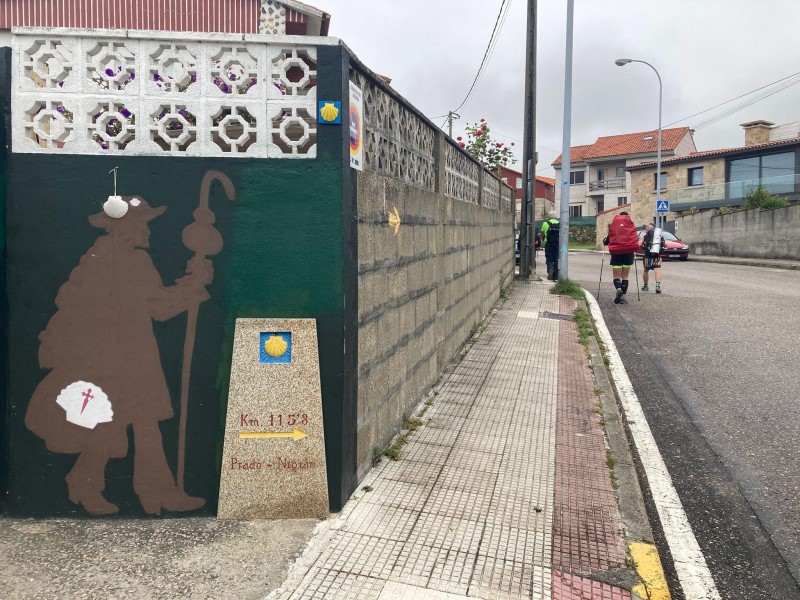 – 115 km still left. On a rainy morning like this one it definitely feels like a lot…
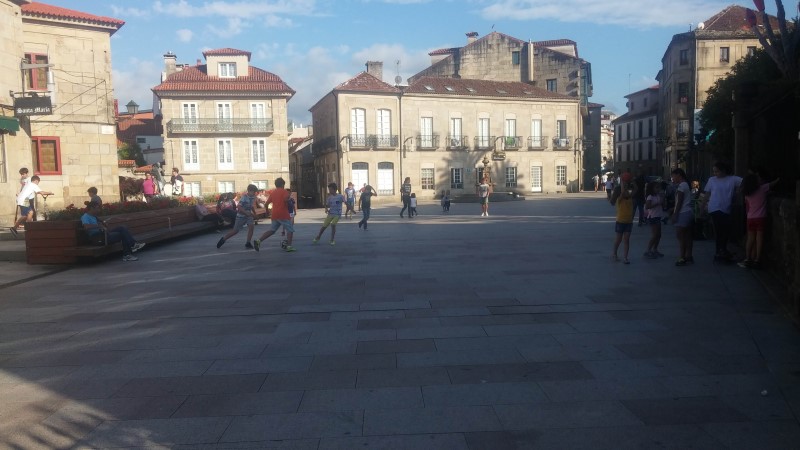 These small Spanish squares with children playing with a ball have their charm…
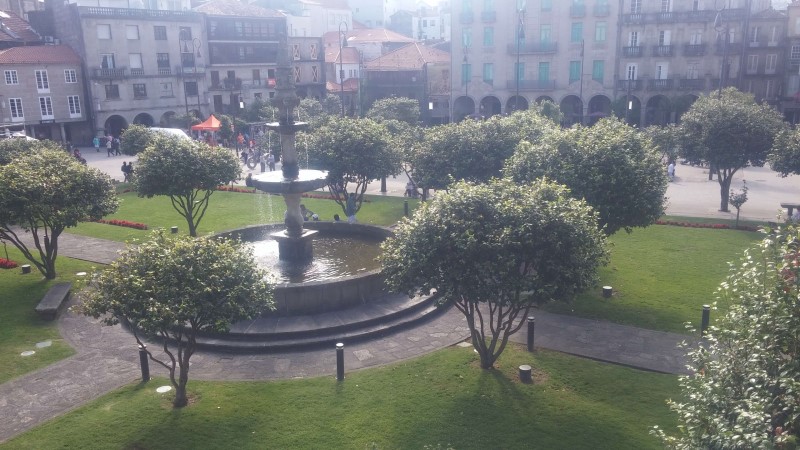 – BIG city. Either you love it or you hate it. I am more into the second group, but for one night on the camino any place would do :).
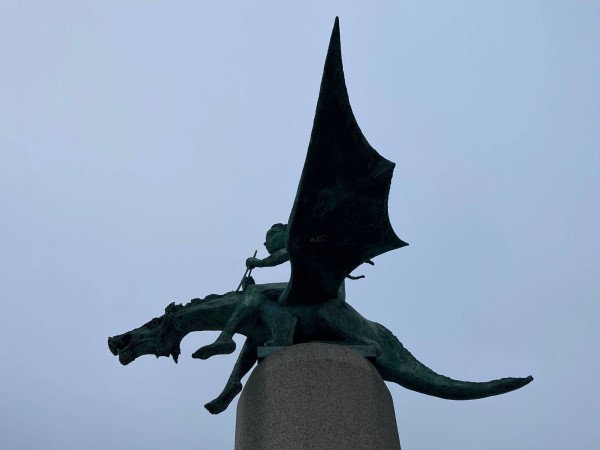 – The famous dragon of Vigo…
Few tips at the end
- Use music to help you get over the last urban stretch. Personally I rarely listen to music while hiking or on pilgrimage, but entrances to big cities are en exception to the rule :). Imagine having already walked 20 km on a hot (or even worse very rainy) day, and then comes the seemingly endless urban industrial stretch of Vigo, honestly, quite ugly… Yet it is also a part of the way, and one can find beauty everywhere with the right perspective. Having said that, if you find this stretch endless, it won’t be a bad idea putting your favorite music in the headphones to help you ‘survive’ the last two hours in this concrete jungle.
Next/Previous Stage
- Next stage: Camino Portuguese de la Costa, Stage no. 8, Vigo – Arcade.
- Previous stage: Camino Portuguese de la Costa, Stage no. 6, Oia – Baiona.



![Ultralight Packing List for Camino de Santiago [2026 Edition]](https://caminolovers.com/wp-content/uploads/2022/03/altra-shoes-640-x-480.jpg)