Table of Contents
Basic Information
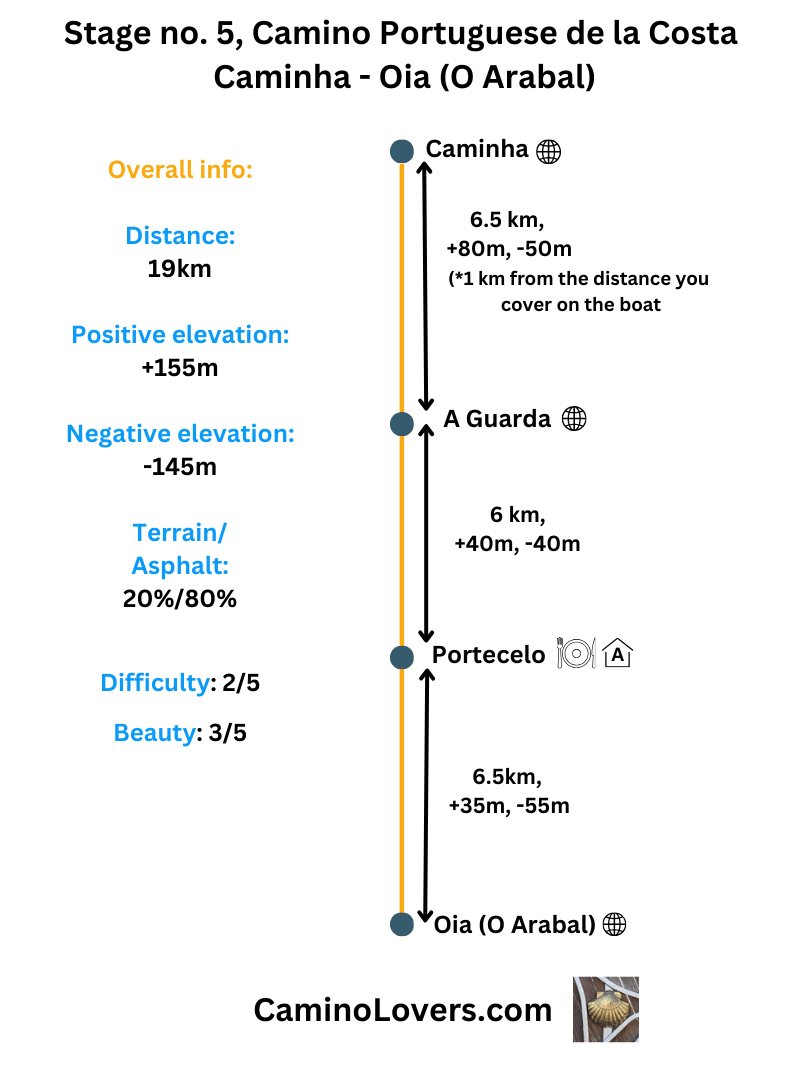
- Starting Point: Caminha, Portugal – A charming border town located at the mouth of the Minho River, right on the frontier with Spain. With over 15,000 inhabitants, the town is very pilgrim-friendly, offering several hostels (with 2 pilgrim-only places), guesthouses, restaurants, and all essential services. During the summer season you can feel the pilgrim vibe in town at every corner.
- Ending Point: Oia, Spain – A small coastal village in Galicia, famous for its dramatic Atlantic coastline and the stunning Royal Monastery of Santa María de Oia, one of the few monasteries in Spain built directly by the ocean.With 3,000 inhabitants you’ll find there all services for pilgrims, although the hostel where I stayed on my Camino isn’t operational anymore… Still, there are other accommodation options in town, and one can find an affordable room for two. For a pilgrim-price accommodation option, you’d need to continue 4km more, to a place called Albergue de Estrella, one of the best rated hostels on entire Camino Portuguese. Considering my suggested stage has only 19 km, it shouldn’t be a problem…
- Availability of an alternative route: NOT really, although for die-hard walkers, who never take any boats on the camino and always look for bridges instead, you can follow this alternative: alternative route, crossing the bridge in Vila Nova de Cerveria, before walking all the way back to the coast. This way is signposted with yellow arrows, and has 45 kilometers. Obviously taking it, you’d likely break it into two parts.
- Map of the stage: map.
- Distance:
- Elevation Difference:
- Official Camino: +145m, -155m
- Alternative route over the bridge in Vila Nova: +340m, -345m
- Difficulty Score: 2/5, for the official route. Obviously the one to avoid the boat would have 5/5, for sheer distance one has to cover on a single day. 45 km with a bigger backpack is tough, regardless of the terrain.
- Beauty Score: 3/5. Although one is always close to the road, it is a nice part of the coast.
- Terrain/Asphalt Walking Ratio: 20%/80%. A few short stretches take you further from the road and closer to the coast, and these are the only stretches where you actually do not walk on tarmac.
- Next stage: Camino Portuguese de la Costa, Stage no. 6, Oia – Baiona.
- Previous stage: Camino Portuguese de la Costa, Stage no. 4, Viana do Castelo – Caminha.
Elevation profile for the route
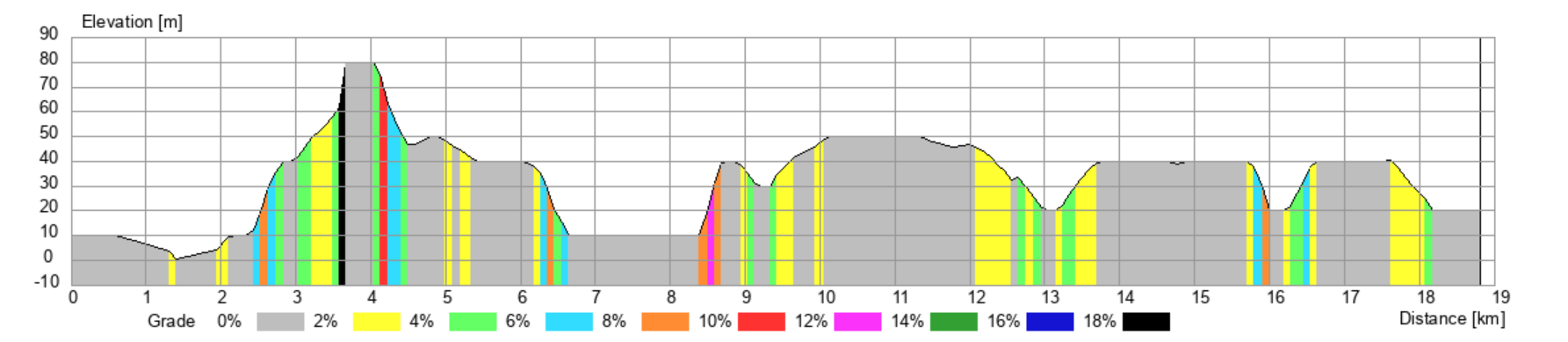
– Not as flat as it was in Portugal, but 150 meters to climb and 150 to descend on 19 kilometers isn’t something that should worry you.
Advanced info about the stage
- Natural Highlights:
- Monte Santa Trega, a small “mountain” near La Guarda, with several hiking paths (well signposted), towers, archeological site, beautiful forest, views, etc. Basically it would do for a whole afternoon (and you can spend it there, should you stay in La Guarda for the night), but it is nice also for 1-2 hour detour from your way. Location on Google maps here.
- A beautiful natural “lake” with fresh water, right on he edge of the ocean. Location on Google maps here, see photos section below to see how it looks :). Great for a refreshing swim on your way, or simply for a nice break outside of the crowds. 100 meters away from the Camino.
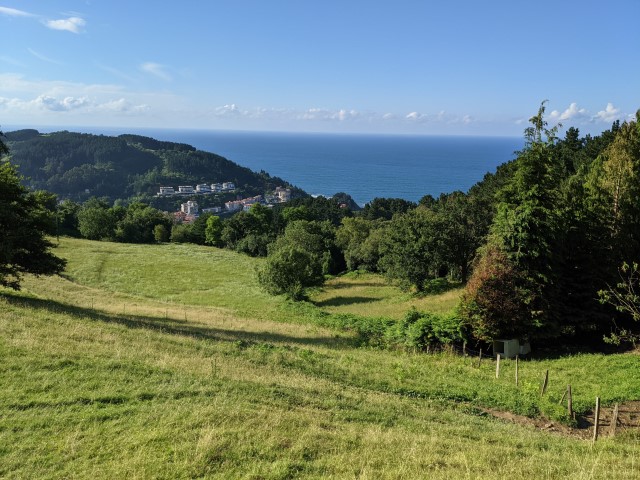
- There are several viewpoints on the way today, some of them right on the camino, some further. And while none of them is breath-taking, each is worth a short stop to marvel at the ocean…
- Historical & Cultural Highlights:
- Margelina archeological site, La Guarda, shortly after boat crossing, 1 km of the camino. Location on Google maps here. Well-preserved remains of a settlement from 4th century BC. Incredible place of history with incredible views. Definitely a detour worth making. It is also great for an afternoon walk should you sleep in Guarda instead of Caminha. Free entry, but there is also a museum nearby, exactly here, with tickets for 1,50 euro, open every day except Monday, from 11am to 5pm. Also worth a visit.
- Cetarea Redonda, after la Guarda, 100 meters detour from the camino, exactly here. A well-preserved stone shellfish nursery built directly into the rocky coast, back in 1895. Fishermen used it to keep seafood alive after catching it until it was sold. Had a lot to do with low tide and high tide, you’ll find explanation onsite. Definitely worth a short detour.
- Royal Monastery of Santa María de Oia, Oia, km 19, including the boat transfer. Location on Google maps here. The only Cistercian monastery in Europe built directly on the Atlantic shoreline, dating back to 12th century. Historically it helped protecting the Galicean coast. Initially followed Benedictine traditions, later joining the Cistercian Order in 1185. Sadly now it has private ownership and getting a chance to visit the insides are hit and miss really. If you get in, the guided visit is 9 euro, no pilgrim discount available. It is beautiful also form the outside though…
- Alternative route info: For die-hard walkers, who never take any boats on the camino and always look for bridges instead, you can follow this alternative: alternative route. It is marked with sparse yellow arrows, and has 45 kilometers. If you decide to take this alternative, I suggest you to spend the next night in La Guard, km 32 of your walk. What to say about the alternative? I’ve personally never walked it, so I can just work with some satellite images and details visible on public maps. From what I can see it has its variety, you pass by several nice river-beaches of Minho river (for example Praia da Mota), also through some nice forest sections, but there are also pretty long urban stretches that dominate this way… To sum it up, I recommend this route only if you have the rule of never taking any transport on the camino, and want to avoid the boat crossing of Minho river. Other than that, it doesn’t make much sense walking it instead of the official camino.
- Camping/Bivouac Options on the Stage: For wild camping/bivouac, I recommend the lake where my friend Peter bivouacked with his group on the camino, exactly here. Should you want to wild-camp/bivouac near Oia, your best chance would be in the zone of the viewpoint Mirador de Oia, exactly here. Just make sure to NOT camp right at the mirador, it’s just too exposed with no real spot to hide your tent. Walk a bit further instead, to one of the small hills nearby, that are pretty flat and offer some good spots to pitch a tent. For example around here. The only official campsite one today’s stage is the following one:
- Camping Santa Tecla (location and reviews on Google maps here), located right after the initial boat crossing from Caminha to Guarda, 1.5 km away from the camino. A nice green camping with small supermarket and swimming pool, dog-friendly, prices from 20 euro/night for one person in tent with access to electricity, you can reserve your spot online. Overall a camping with good reputation and clean facilities, can be extra busy in summer, that’s why I recommend making a reservation of your spot a day in advance (to make sure you don’t walk 1.5 km away from the camino just to stay without a place to pitch a tent…).
- Dog-Friendly Score: 3/5. First the good news–all boat taxi services, taking you over the Minho river from Portugal to Spain, accept dogs onboard, typically with no extra charge. Other than that the stage isn’t ideal for dogs, with lot of asphalt walking and little shade. For a dog-friendly accommodation I recommend an albergue called Alojamiento Camino Portuguese Oia, location and reviews on Google maps here. It is 6 km after the monastery, making this stage 25km long instead of 19km. Considering there’s no other affordable dog-friendly place before this one, however, I recommend you covering the extra distance.
- Special Remarks:
- The names of smaller towns in Galicia can be confusing, especially for English speakers. On some maps you may see Spanish name(s), and on other maps, or apps you may use, they show Galicean names (read more about this language here). Sometimes the difference is just one letter, and sometimes the name is completely different. I write this to make sure you won’t panic seeing yourself entering the town that seemingly isn’t on our guide, or on some other camino guide you use. It is probably there, just the name is different :).
- If you’re into walking camino Portuguese in 10 days (our guide has 11 stages), this is one of the stages where you can continue on, and cover some good distance on your way to Santiago.

My picks for accommodation on this stage
- Albergue O Peirao, A Guarda, km 6. Location and reviews on Google maps here. The first good albergue “on the other side”, meaning in Spain. 16 beds in one dorm, but good beds that offer a bit of privacy with curtains. Very nice staff, well-equipped kitchen, has all a pilgrim needs. The location is also great, pretty central. For 20-22 euro/night it is definitely worth the price. Recommended way of making a reservation: Booking.com, exactly here. Check-in from 2pm.
- Aloxamento A Mariña, O Arabal, km 16. Location and reviews on Google maps here. Nice private rooms (there aren’t many albergues in this particular zone of the camino, and due to the number of pilgrims passing by, it is often necessary to stay in a private place once). 4 rooms, prices from 60 euro/night (changing during the season), which isn’t too bad for a couple. Everything spotlessly clean and modern, location right on the camino. Check-in available 24 hours. Recommended way of making a reservation: On Booking.com, exactly here.
- Hotel A Raina, Oia, km 19. Location and reviews on Google maps here. The only bigger hotel in Oia that hosts pilgrims and accepts one night stays. You can check all details on Booking.com, exactly here. 200 meters from the Camino, prices start at 60 euro/night for a single room, 12 rooms in total. It is more economical sharing a room with another pilgrim, since you can get the double for 75 euro. A good place where many pilgrims stay. Check-in from 3pm.
- If you want to stay only in albergues/hostels, you’ll have to continue 3.5 kilometers more, to a place called Albergue de Estrela. Location and reviews on Google maps here. It is a great place, with excellent reviews across all pilgrim platforms. 20 euro/night, 15 beds in two rooms, friendly hosts, everything new and modern, right on the camino. Check-in from 2pm. They accept reservations, send WhatsApp to +34 649 286 110, or +34 603 498 311. The only problem is that due to lack of any hostels in this zone, and a high number of pilgrims on this camino, getting a bed here is very tricky, unless you reserve a lot in advance. But if you can get a bed here, it is definitely a great place to stay….
Pictures from the stage
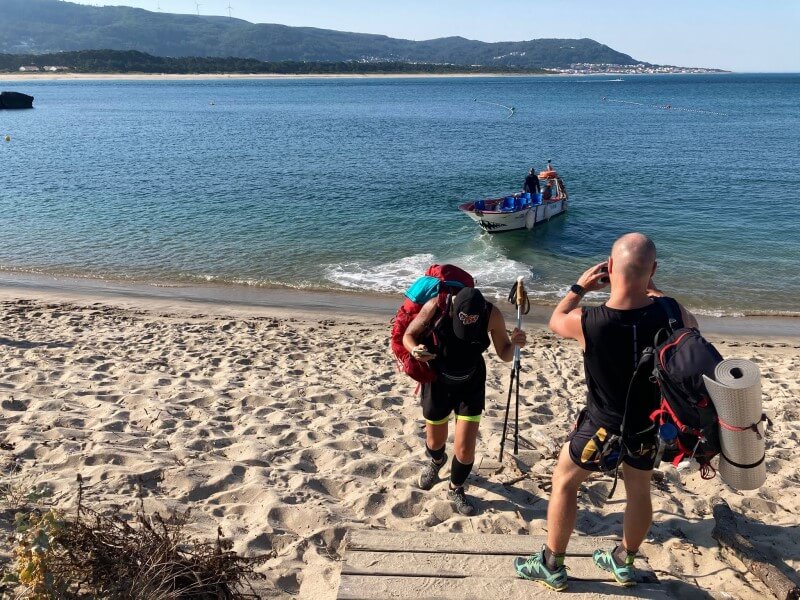
– Have we just crossed to the other side?
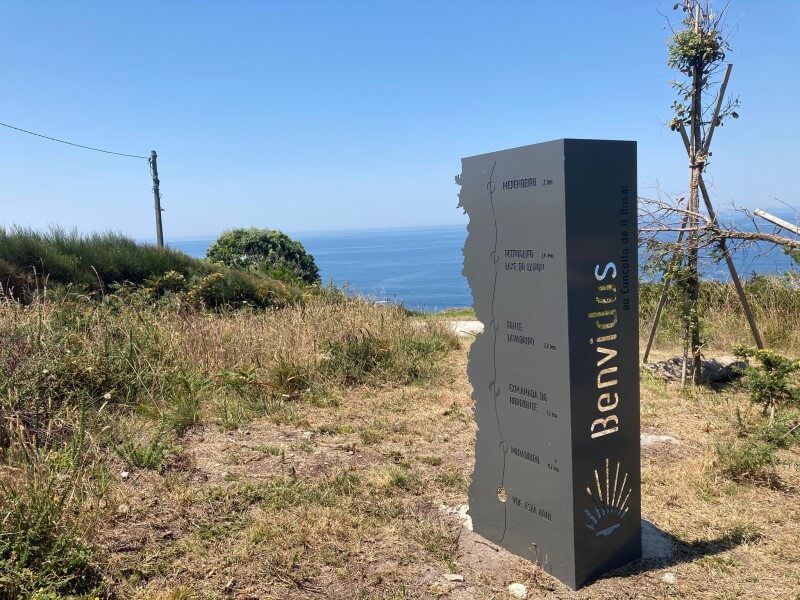 – It seems so. Goodbye Portugal!
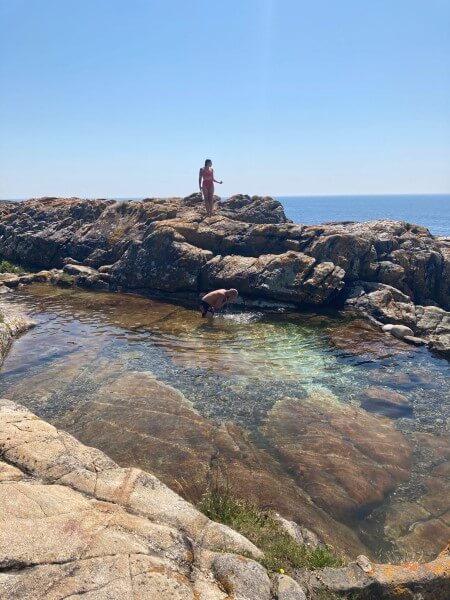 -A secret lake on the way. Or maybe not as secret anymore. Anyway, if you’d like to have a swim there, or even camp ,you’ll find it here.
 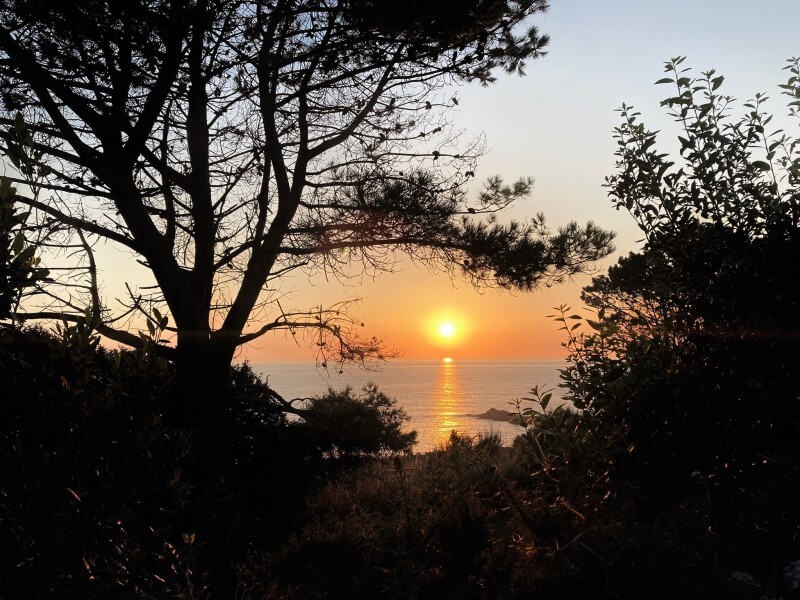 – A sunset at the sea never gets boring, does it?
Few tips at the end
- In general, Portuguese people tend to speak English better than Spanish people. And in Galicia it is even worse :). Of course, with a massive growth of popularity of this camino, you may get around in some albergues and hotels “on the Spanish part” of this way just with English. Nevertheless, it is good learning at least basic stuff, such as “necesito una cama, por favor” (I need one bed, please), or “cuanto cuesta” (how much is it?).
Next/Previous Stage
- Next stage: Camino Portuguese de la Costa, Stage no. 6, Oia – Baiona.
- Previous stage: Camino Portuguese de la Costa, Stage no. 4, Viana do Castelo – Caminha.



![Ultralight Packing List for Camino de Santiago [2026 Edition]](https://caminolovers.com/wp-content/uploads/2022/03/altra-shoes-640-x-480.jpg)