Table of Contents
Basic Information
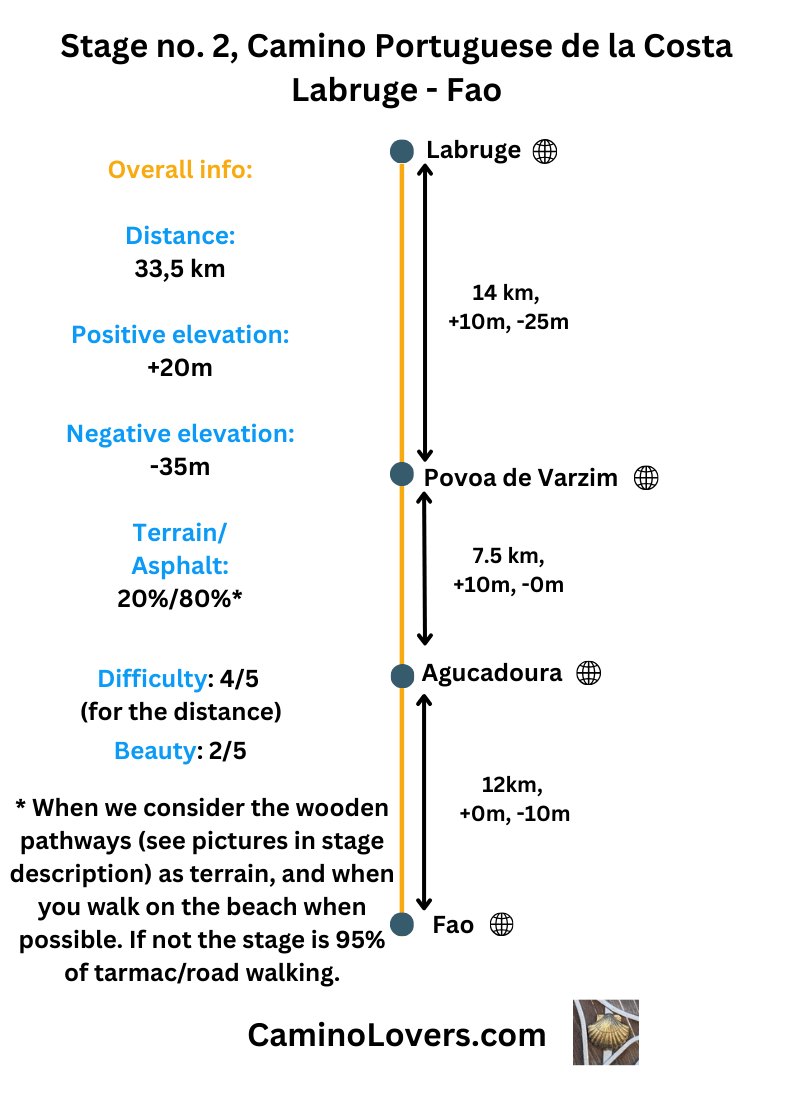
- Starting Point: Labruge, Portugal – A small coastal town north of Vila do Conde, known for its long sandy beach, dunes, and relaxed atmosphere. With over 3,000 inhabitants, Labruge has all basic services a pilgrim needs, including a large pilgrim-only hostel with 67 beds, and a few other accommodation options.
- Ending Point: Fão, Portugal – A quiet riverside town located at the mouth of the Cávado River, just south of Esposende. Fão has a calm, authentic Portuguese feel, but with over 3,200 inhabitants, you’ll find in town 3 hostels, and many other accommodation options for each budget. It also offers all services for pilgrims, such as shops, restaurants, pharmacy, post office, etc.
- Availability of an alternative route: YES, in the first part of the stage you can go directly to the coast, and spend a bit more time right at the edge of the Atlantic ocean. The arrows are sparse here (it isn’t an official Camino), but each year people paint more and more yellow arrows also on this alternative. What’s more, there’s no way of getting lost, since you simply always have the ocean on your left side. The alternative route is 1km shorter than the official Camino, and has a bit less asphalt walking.
- Maps:
- Distance:
- Elevation Difference:
- Official Camino: +20m, -35m
- Alternative route: +10m, -25m
- Difficulty Score: 4/5, mainly for the distance, because the terrain is easy and there’s no elevation. However, on a very hot day or on a rainy one the 32km may seem endless, so you may consider choosing a different ending point of this stage, considering the circumstances.
- Beauty Score: 2/5, maybe 3/5. There are some nice stretches along the coast, but it lacks a bit of variety, plus there’s lot of asphalt walking. Hence I opted for this score, for both the official camino and the alternative variant.
- Terrain/Asphalt Walking Ratio: 20%/80%,more or less for both routes.
- Next stage: Camino Portuguese de la Costa, Stage no. 3, Fão – Viana do Castelo.
- Previous stage: Camino Portuguese de la Costa, Stage no. 1, Porto – Labruge.
Elevation profiles for the routes
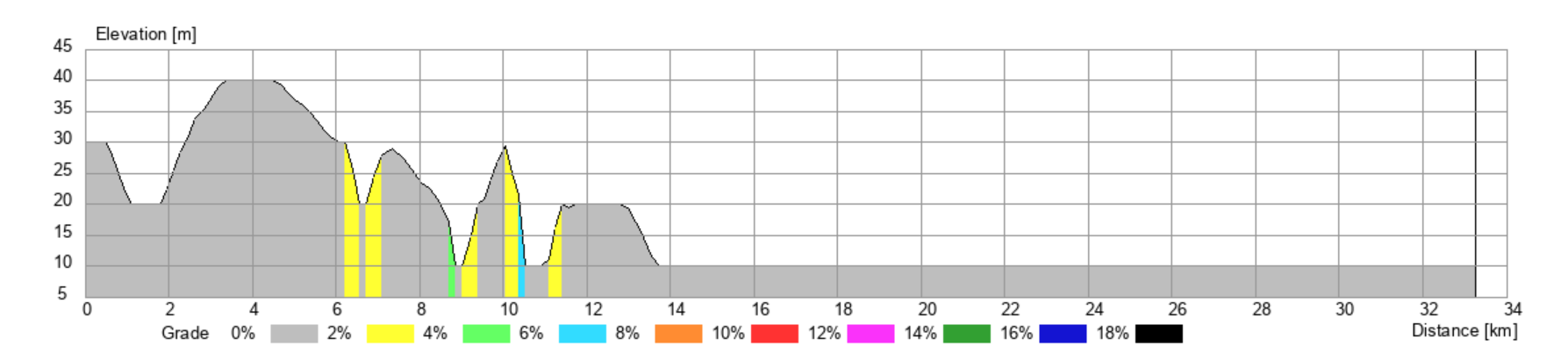
– Official camino, very flat. As you can see on the longest climb of the day you will climb just above 20 meters, on more than 1 kilometer, which is a barely noticeable gradient.
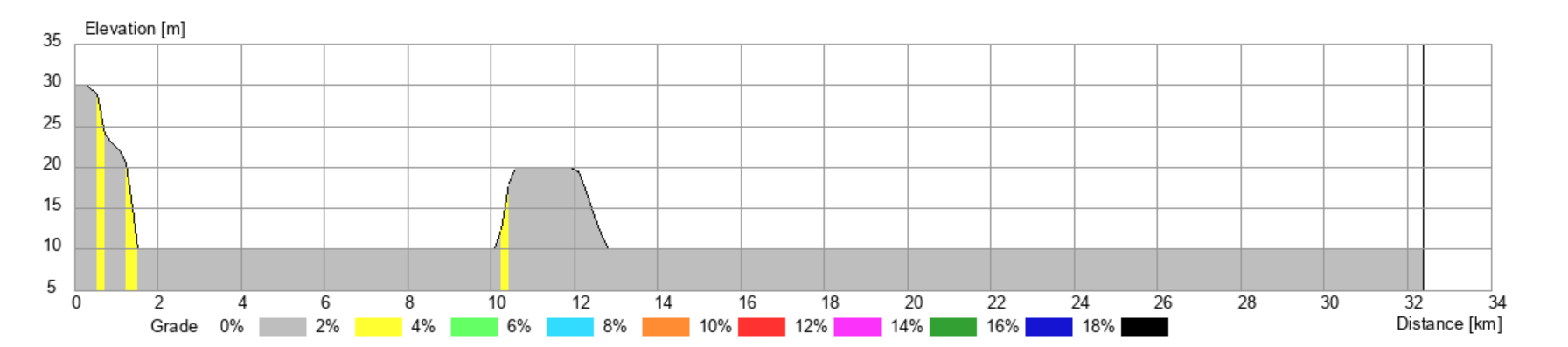
– Even more flatter than the official Camino. Simply this stage is a bit FLAT, and not only in this sense :).
Advanced info about the stage
- Natural Highlights: On this stage, the main natural highlights are the beaches. My favorite ones are below, together with the best place to visit once you’re in Fao, with your backpack already in the hostel:
- Praia de Moreiro Norte, for some interesting rock formations where big waves break nicely on any day. On the alternative route, here.
- Praia de Mindelo, with an interestingly shaped bay in the middle. Also on the alternative route, here.
- Praia da Apulia, for it’s beautiful colorful surroundings and total summer vibe, here.
- Natural park of Fao, in Fao, here. A great place for walks, with both populated and solitary places. Sand dunes, river birds, interesting vegetation, romantic wooden pathways. Definitely a nice walk for your afternoon/evening, once you’re already without a big backpack. Just very few people reach the beaches with dunes at the very end of the park, so there you can enjoy the ocean also in solitude, even during the high season on this camino (when solitude is hard to find in these corners of Portugal…)
- Historical & Cultural Highlights:
- Nau Quinhentista, Vila do Conde, km 10, location and reviews on Google maps here. 300 meters from the camino. A museum with miniatures of 16th century ships, of the great adventurers of the past, who left the European coast heading to unknown, dreaming of returning rich, and often finding nothing but death in the Atlantic… There is a life-size replica of one ship in front of the museum. Definitely worth a visit (even if a short one while you pass through the town on your camino), tickets for 2,50 euro, no pilgrim discount. Open every day except of Monday, from 10am to 6pm, so you’ll typically pass by during the opening hours.
- Aqueduto de Santa Clara, Vila do Conde, km 10, location on Google maps here. Basically right on the camino. The 2nd largest aqueduct in Portugal, almost 4km long, built in 17th century. In pretty good condition.
- Casa do Moinho, Estela, km 28, location on Google maps here. Right on the camino, an old mill building, very well preserved. Now it also serves as a small coffee shop, offering fresh orange juice, coffee, and even simple snacks, in a nice place in shade. Definitely worth a stop before the final push to Fao.
- Alternative route info: To join the alternative route, you return back to the ocean from the albergue in Labruge, or from any other accommodation where you spent the night. The easiest way is following our GPS, or at least the map, check the basic info about the stage (on the top of this article) for links to both the GPS and the map. Big part of this way follows what is called now “Camino Portuguese de la Costa MTB“, meaning a very coastal alternative for mountain bikes. It is sparsely marked with yellow arrows, and sometimes also with other signs. Passes though some nice spots, especially the beach Praia de Moreiro Norte and Praia de Arvore. On the bridge to Vila do Conde, exactly here, it merges with the official camino and stays so all the way until Fao. The way is 1 km shorter than the official camino and even flatter, though the official camino is also super flat :). I would say on a sunny day with not too much wind it is good taking the coastal alternative.
- Camping/Bivouac Options on the Stage: I will again discourage you from wild camping on this stage. However, if you need to camp at any costs, you can try your luck in the natural park called Parque Natural do Litoral Norte right before Fao, somewhere around here. It is flat, there are some pines and other trees (though not as many as someone with a tent would like), and you can hide there with a tent. Just make sure to pitch it right before darkness. There is also an official camping place in Fao, called Camping Park Fao. You can check the location on Google maps here. I recommend it especially during the week, since the place is populated by “domingueros” from Porto over the weekends, and you won’t have a good night sleep… Anyway, during the week it is fine and you can pitch your tent for roughly 20 euro, including electricity. The installations are pretty decent and the beach just 5 minutes walk away. Not a bad camping for a night or two…
- Dog-Friendly Score: 3/5. The terrain isn’t too bad, there’s still a lot of sand, couple of river crossings (where your dog can refresh itself), and some stretches every dog will enjoy. On the other hand, the landscape is still pretty open with a few trees here and there, so on a hot day it is important starting early with your dog. When it comes to accommodation, there are two dog friendly hostels on this stage. First one is in Apulia, 4 km before Fao, and you can check it out here, with all reviews and photos. Make sure to leave a note that you’re coming with a dog when making a reservation! The other one is the hostel Spot, in Fao, that I recommend in the section below (no. 4 on the list).
- Special Remarks: If 34 kilometers feels like a overkill to you, especially on the 2nd day of walking, I recommend staying for the night in Aguçadoura, km 21 of today’s walk. There’s a great new albergue that I describe in the section below. Having said that, 34 flat km many people can easily walk in 7/8 hours, and if you have a bit of time pressure and want to do the entire camino (with flights included) in 2 weeks time (which was my way of thinking when deciding about the stages of this guide), this is a good day to cover a lot of distance… There are more shorter days ahead.
My picks for accommodation on this stage
- Albergue de peregrinos São Mamede de Vila Chã, Vila Cha, km 3. Location and reviews on Google maps here. A very nice municipal albergue with 20 beds in 2 rooms, for 10 euro/night. All installations in decent or better conditions, kitchen well equipped, close to the beach. In my opinion excellent value for the price. Only for pilgrims, open 2pm, doesn’t accept reservations. Since Vila Cha isn’t an official ending of a stage on any major camino app or guide, it is easier getting a bed here then in Labruge for example.
- Albergue de peregrinos São José de Ribamar, Povoa de Varzim, km 14. Location and reviews on Google maps here. A parochial albergue (run by a catholic church) with 36 beds in 4 rooms. 150 meters from the beach. 10 euro/night is again a treat. The place is a bit older and one can feel it on the conditions of the beds (and the mattresses) and some installations, but it has its charm. There’s a service for pilgrims and pilgrim blessing in the evening (ask the host for the exact hour). Doesn’t accept reservations, opens at 2pm, and is closed on Mondays.
- Albergue de peregrinos de Aguçadoura, Agucadoura, km 21. Location and reviews on Google maps here. New beautiful luminous pilgrim hostel, right on the beach. 15 euro/night, 24 beds in 4 rooms. In contrary to most albergues in this zone it accepts reservations, and you can make one on the following phone number: +351 252 034 493 (I recommend WhatsApp). Ideal for people who find the distance to Fao too large, and prefer to walk just around 20 km. Has good kitchen, beds in excellent condition, garden, nice communal space. Highly recommended.
- The Spot Hostel Ofir, Fao, km 33. Location and reviews on Google maps here. One of the best-rated hostels on entire camino Portuguese, across all platforms. New and beautiful, with both shared rooms (including female only room), and private rooms for more comfort. Swimming pool, small garden, central location, with everything you may need pretty close nearby, most of the year most of the guests are pilgrims :). Accept reservations, recommended way to make a reservation: Booking.com, exactly here. Check-in from 3pm.

Pictures from the stage
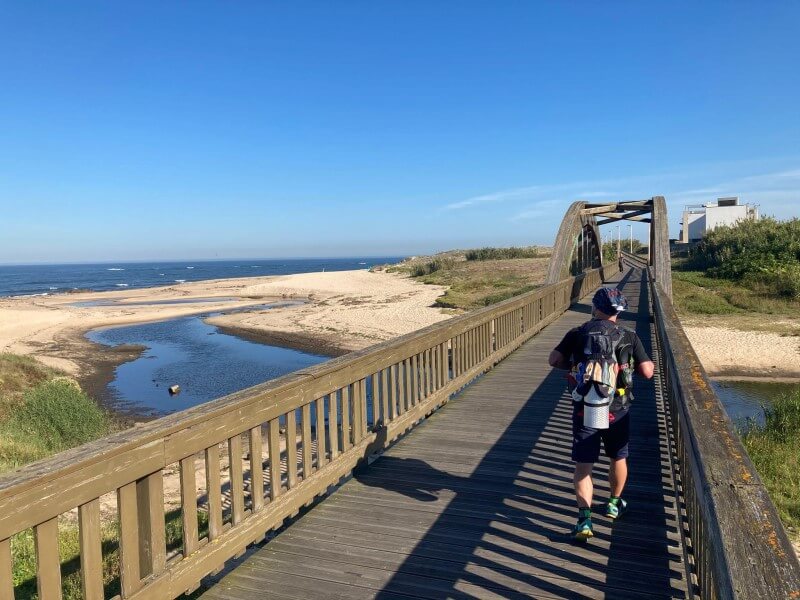 – Wooden pathways, so typical not only for this stage, but for the entire northern coast of Portugal. It would be hard counting how many of them you will cross until reaching Santiago, but you can give it a shot and then let me know :).
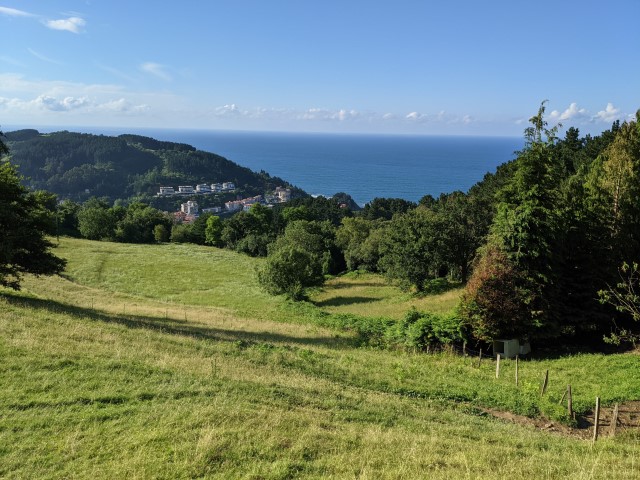
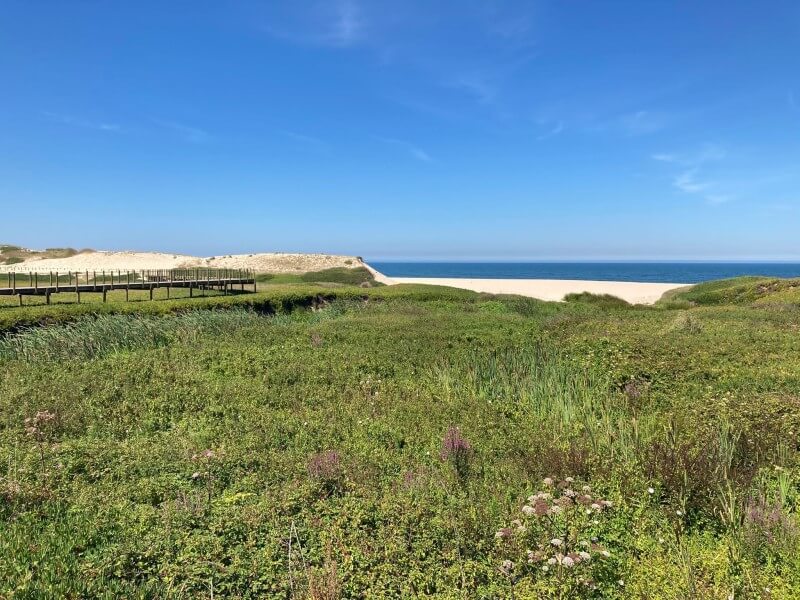 – A very typical Portuguese coast. Let of greenery, but not cliffs. Dunes are also quite common.
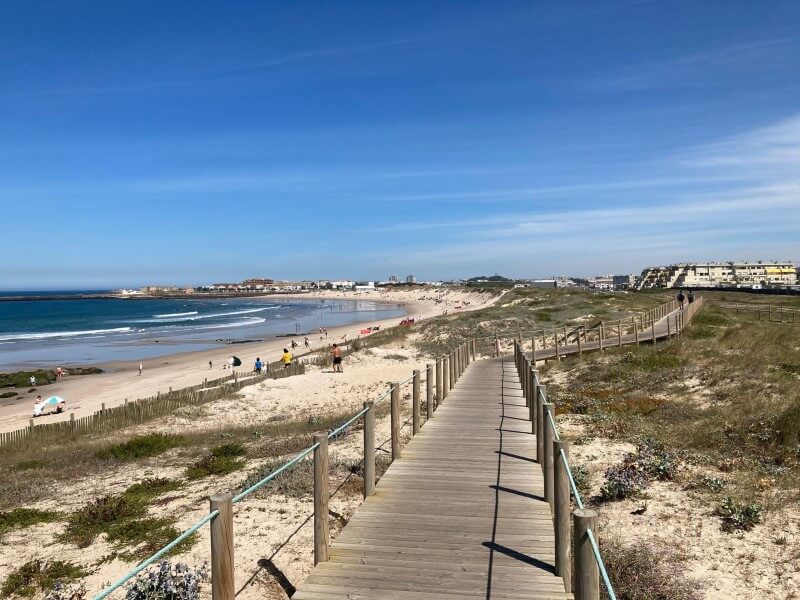 – As you can see, the beaches get quite busy in July. There are plenty of hotels along the coast as well.
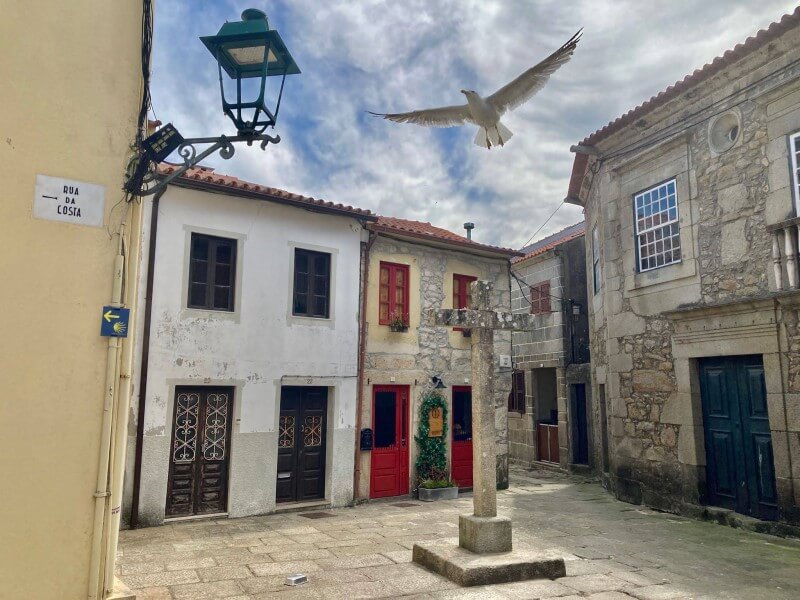 – A lucky catch of a seagull on a small charming square on the way.
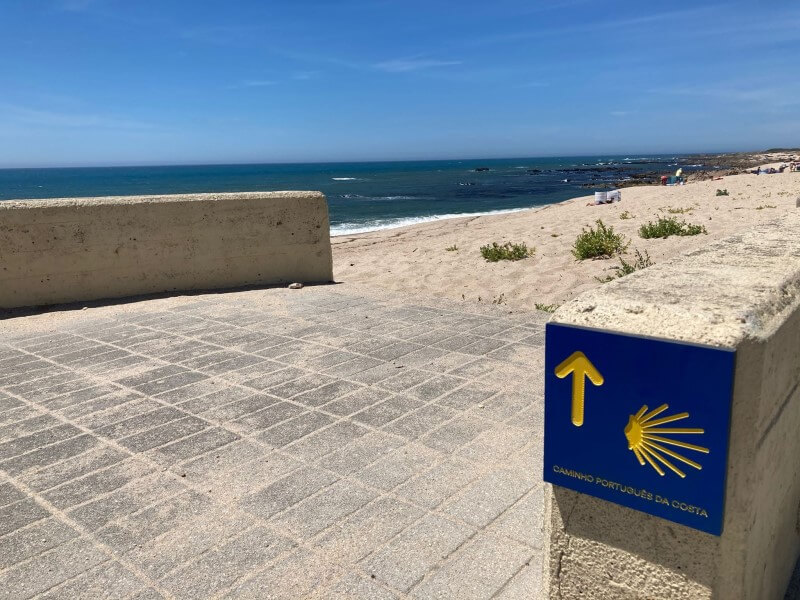 – Generally speaking, this camino is signposted pretty well.
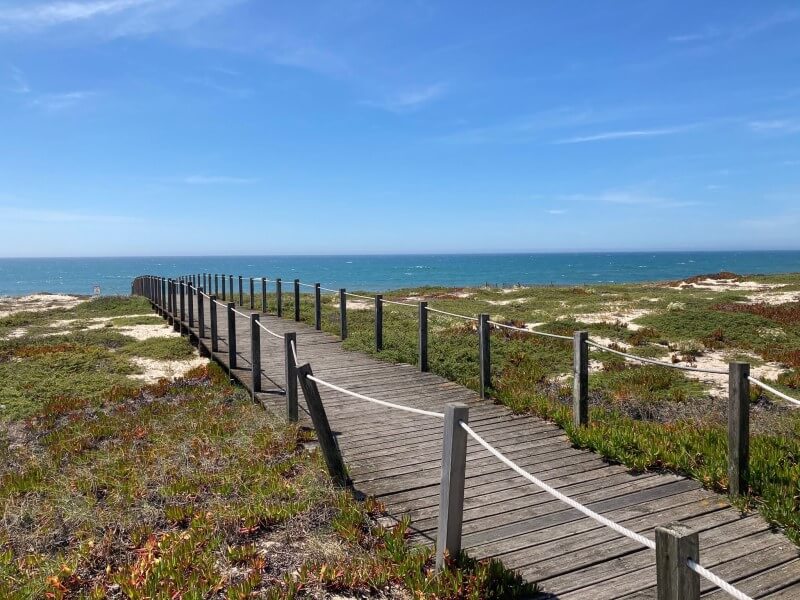 – Pathway to heaven.
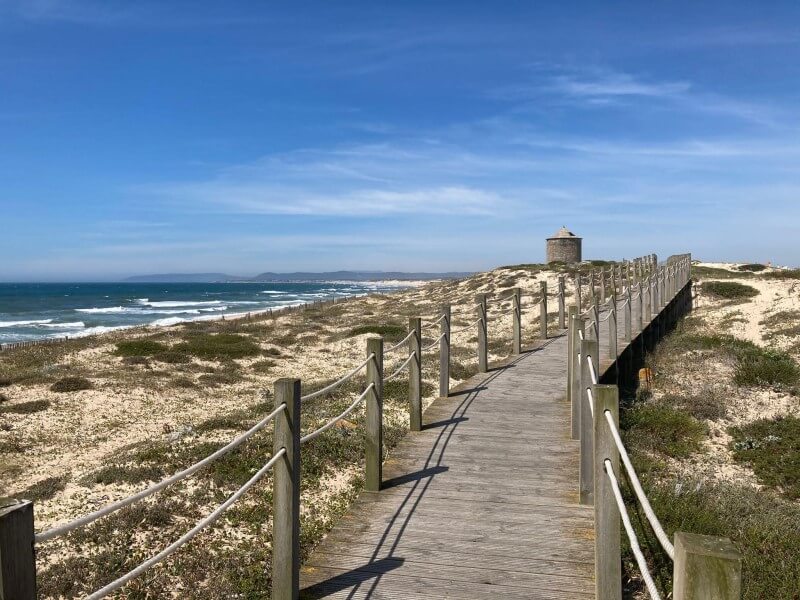 – The waves are almost always quite big, unless you are in one of the beaches with a bay… The building you see on the picture is the old mill of Agucadoura, exactly here.
Few tips at the end
- It is key to not underestimate the strength of Portuguese sun, especially if you walk this way between June and August. I saw quite a few people quitting the camino because of sun stroke. As you can see from the pictures, you walk mostly in the open terrain, which is nice for views, but bad for the lack of shade. Hence wearing a cap or at least a buff as a form of sun protection is highly recommended. Alternatively you can take an umbrella and use it as a parasol when needed. I do it on my caminos, and while some locals have a good laugh about it, I’ve never suffered any heatstroke on the way :).
Next/Previous Stage
- Next stage: Camino Portuguese de la Costa, Stage no. 3, Fão – Viana do Castelo.
- Previous stage: Camino Portuguese de la Costa, Stage no. 1, Porto – Labruge.



![Ultralight Packing List for Camino de Santiago [2026 Edition]](https://caminolovers.com/wp-content/uploads/2022/03/altra-shoes-640-x-480.jpg)