Table of Contents
Basic Information
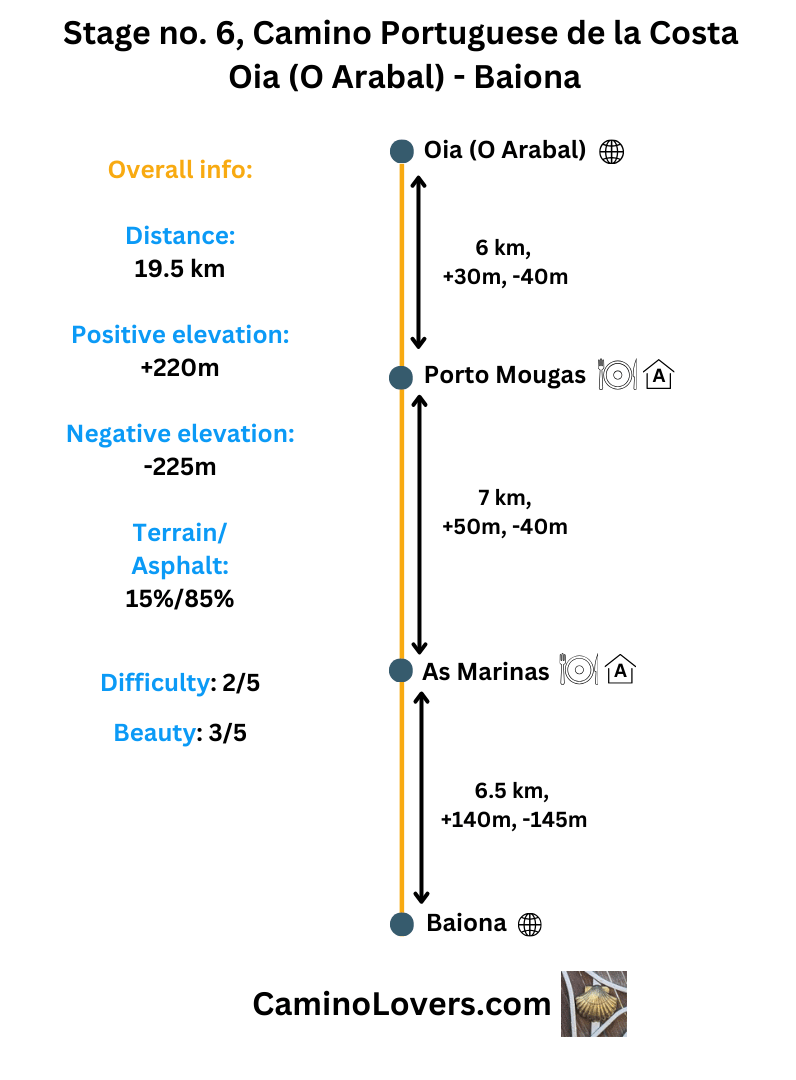
- Starting Point: Oia, Spain – A small coastal town in Galicia, famous for its dramatic Atlantic coastline and the stunning Royal Monastery of Santa María de Oia, one of the few monasteries in Spain built directly by the ocean.With 3,000 inhabitants you’ll find there all services for pilgrims, although the hostel where I stayed on my Camino isn’t operational anymore… That’s a business opportunity by the way, if you ever dreamed of opening a pilgrim hostel in Spain 😉
- Ending Point: Baiona, Spain – A lively coastal town with a rich maritime history, famous for being the first place in Europe to receive news of the discovery of America. With around 12,000 inhabitants, Baiona is very welcoming to pilgrims and offers a wide range of services, including one pilgrim-only hostel, another hostel, and plenty of other accommodation options, including one Parador hotel, where the rich pilgrims stay :).
- Availability of an alternative route: YES, there is a nice alternative following a hiking route (waymarked) called Ruta Maxica (Magic route), over some hills, forests, waterfalls, and basically a kind of terrain that isn’t typical at all on this camino. It is 9 km longer, and has more elevation. But if you’re not in rush, walking this alternative way will be one of the highlights of your Camino, no doubt. I describe it more in “advanced info about the stage” section.
- Maps:
- Distance:
- Elevation Difference:
- Official Camino: +220m, -225m
- Alternative route over Ruta Maxica: +630m, – 635m
- Difficulty Score:
- Official Camino: 2/5.
- Ruta Maxica alternative: 4/5.
- Beauty Score:
- Official Camino: 3/5.
- Alternative over Ruta Maxica: 4/5. The official variant isn’t bad either, but the one with Ruta Maxica and later the coastal part of the official camino can make this stage the nicest stage of all Camino Portuguese de la Costa. Of course if the weather is good, which is never guaranteed in Galicia :).
- Terrain/Asphalt Walking Ratio:
- Official camino route: 15%/85%.
- Alternative route: 35%/65%.
- Next stage: Camino Portuguese de la Costa, Stage no. 7, Baiona – Vigo.
- Previous stage: Camino Portuguese de la Costa, Stage no. 5, Caminha – Oia.
Elevation profiles for the routes
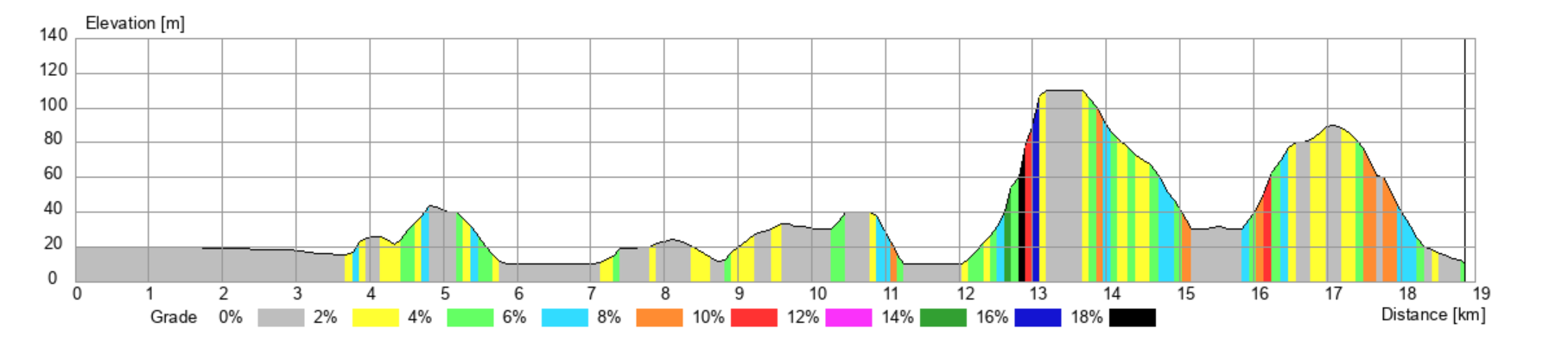
– Official camino, first 12 kilometers are very flat and then things heat up a bit, with the steepest climb between km 12 and 13, with gradient sometimes surpassing 16%. Then one more climb before the end. Still, climbing 220 meters on 19 kilometers cannot be considered a mountainous stage, in any means :).
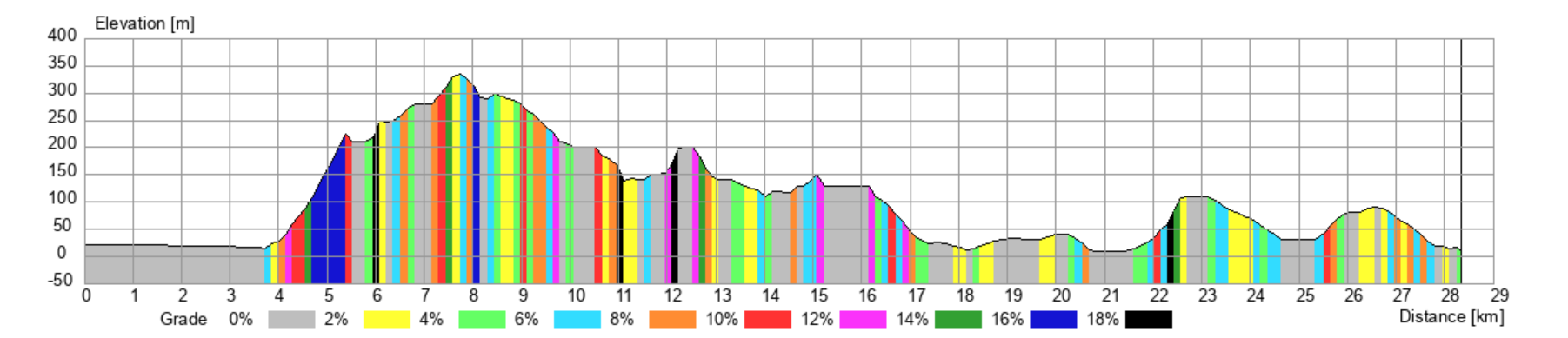 – Ruta Maxica alternative. After first 4 flat kilometers, identical with the official Camino route, things heat up considerably, with several climbs and descends, some of them rather steep. 630 vertical meters over 28 kilometers isn’t anything super dramatic, but it is likely the most elevation you’ll cover on this camino on a single day…

Advanced info about the stage
- Natural Highlights:
- Ruta Maxica, the alternative route. Pine forests, waterfalls, beautiful views and a peaceful path away from the Camino crowds. The alternative route is definitely the natural highlight of this stage, and one of the natural highlights of the entire Camino Portuguese de la Costa. See more info in the section about the alternative route.
- Monte Silleiro, with its Mirador de Cabo Silleiro, and a beautiful lighthouse (now changed into a hotel) called Faro de Cabo Silleiro. The viewpoint (mirador) is about 500 meters detour from the Camino, while the lighthouse is 2 km detour. Both places are well-worth visiting. Beautiful views, varied landscape and a lighthouse that’s hard to forget…
- Historical & Cultural Highlights: Definitely the town of Baiona. It is beautiful with plenty of landmarks and places to see for history and culture lovers. In towns like this it is sometimes best walking without a purpose (and a mobile phone), getting yourself lost in the streets and summer vibe of the town, enjoying the beauty of this town with rich maritime history… If I should pick a couple of places to see in particular, however, it would be:
- Monte Boi Park, location on Google maps here. Walking the park feels a bit like a mini coastal Camino stage: waves crashing below the cliffs, fortress walls above you, views of fishing boats and the open Atlantic, and some quiet pine forest sections.
- Replica de Carabela Pinta, location on Google maps here. A full-size replica of the famous ship La Pinta, one of the three vessels used by Christopher Columbus during his first voyage to the Americas in 1492, built in 1993 to commemorate the 500th anniversary of Columbus return to Europe, declaring the discovery of America. Entrance fee 2 euros, open every day except of Monday.
- The Virgin of the Rock statue, location on Google maps here. A 15-meter-tall granite statue of the Virgin Mary built in 1930. One of the most unusual features is that the statue is hollow. Inside there is a spiral staircase that leads up through the statue to the boat-shaped structure in Mary’s hand, which functions as a viewing balcony. Unlike most Marian statues, the Virxe da Rocha holds a boat instead of a child or a crown. This symbolizes protection of sailors and fishermen and the strong maritime tradition of Baiona… Entrance fee to the staircase is 1,50 euro. But it is well-worth visiting the place even if you don’t go inside of the statue :).
- Alternative route info: The alternative route over the Ruta Maxica is highly recommended, especially in good weather. Not only will you leave the crowds to pass through landscapes different to what you normally see on this camino. In good weather, it is also one of the nicest stretches of the entire way. Pine forests, rivers, waterfalls, stunning views. I strongly suggest you to download our GPS to your device (or your favorite mapping application on your phone), but you can also follow the instructions I will give you right now. So, you should leave the camino exactly here, turning right, climbing steadily over a street called Camino de Espineiro. Basically going up all the time, even if you choose wrong path at the top of the street, you will eventually reach Ruta Maxica. Just make sure to always go UP :). The route itself is signposted with information panels on crossroads, and also painted circles. You will return to the Camino in Puerto Mougas, exactly here. If your sense of orientation isn’t great, however, or you simply want to feel 100% secure on your way, the best bet is following either our GPS, or our map of this alternative route while on the way…
- Camping/Bivouac Options on the Stage: While Ruta Maxica and other pine forest sections of today’s stage definitely represent a kind of terrain where one can pitch a tent, and sleep calmly, on this stage I would still opt for official camping place. There are quite a few of them, they are always located close to the ocean, and overall have decent ratings across all platforms. As it is typically the case, competition makes things better for the customer :). Here are the two best options for pilgrims:
- Camping O Munio, location and reviews on Google maps here. Km 8 of today’s walk, right on the camino. A beautiful spot at the edge of the ocean, with built in bungalows but also parcels to pitch your own tent. Two swimming pools, cafeteria, enough trees. 14 euro/night for one person in a tent. Can be a bit cheaper in low season and a bit more expensive in high season. Dog friendly, you pay 4 euro extra for a dog. Good value for money, pretty well rated across various platform.
- Camping Playa Baiona, location and reviews on Google maps here. 500 meters detour from the camino, km 20, in the ending town of today’s walk. A beautiful campsite on a beautiful beach, close to everything and yet away from the city buzz. Gets pretty busy in July and August. Pricing is set more for groups and couples, and for “campers” with cars… Hence you can get a place there for about 55 euro/night, for a tent with 2 people. Dogs are 4 euro extra here as well. Not the cheapest camping on the camino, but if you can afford it, it is well worth paying it.
- Dog-Friendly Score: 4/5, following the Ruta Maxica. It’s the kind of terrain dogs enjoy, hills, forests, always a fresh water nearby… Of course, the entire stage isn’t like that, and the official variant would have lower score, but with the dog I strongly suggest you to follow Ruta Maxica alternative. When it comes to dog-friendly accommodation, your best bet are the camping places along these stage (see the section above for more info). The albergues on this stretch don’t accept pilgrims with dogs.
- Special Remarks: On this stage, you cross the halfway mark of your way to Santiago :). As every experienced pilgrim knows, the first 5-6 days of any pilgrimage are the toughest. That’s how long it takes your body to get accustomed to the heavy backpack and the routine of walking many kilometers a day, day after day. Hence if you by any chance experience some crisis the last few days, things should get only better from now on!
My picks for accommodation on this stage
- Albergue de Estrela, Viladesuso, km 3.5. Location and reviews on Google maps here. It is a great place, with excellent reviews across all pilgrim platforms. 20 euro/night, 15 beds in two rooms, friendly hosts, everything new and modern, right on the camino. Check-in from 2pm. They accept reservations, send WhatsApp to +34 649 286 110, or +34 603 498 311.
- Albergue Estela do Mar, Baiona, km 19.5. Location and reviews on Google maps here. Pilgrim oriented hostel in excellent location (close to the Monte Boi, the nicest location in Baiona, with beaches, towers, green zone, etc). 20 places in one big dorm, plus some private rooms. 18-20 euro/bed, sometimes can go up in high season. Lot of attention to small details, nice communal zones inside and outside the house. Recommended way to make a reservation: WhatsApp on one of the following numbers: +34 986 133 213, +34 604 034 227, or Booking.com, exactly here.
- Hostel Albergue Baionamar, Baiona, km 19.5. Location and reviews on Google maps here. Another excellent hostel in Baiona. Everything is very similar to the other one–18-20 euro/bed, 18 places. Check-in from 2pm. The reason why I like the one before better is that this one doesn’t have any kitchen for pilgrims (only fridge and microwave), and also doesn’t have such a nice communal zone outside. But in any case, it is a great place for a stay for one night, and the rooms are distributed in 2 rooms, so less chance for snoring when compared to the other hostel in Baiona :). Recommended way of making a reservation: Booking.com, exactly here.
Pictures from the stage
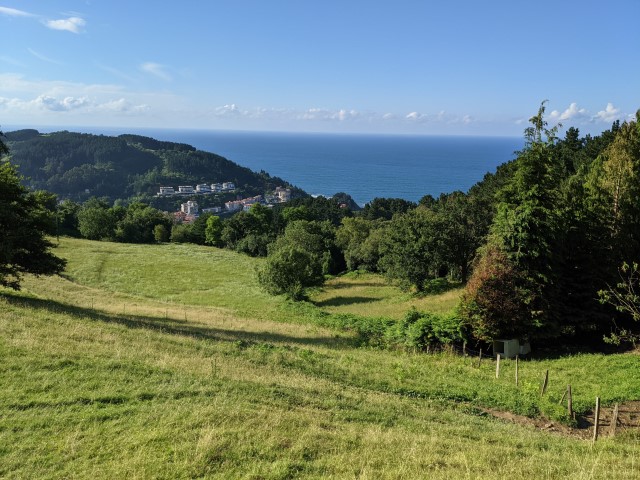
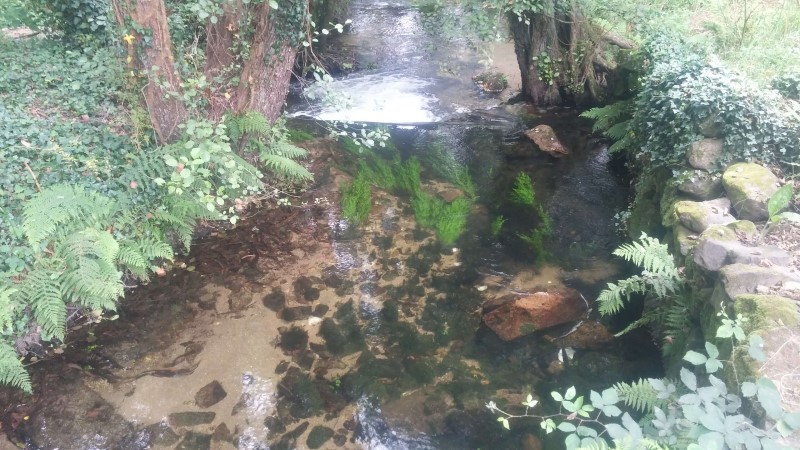 – Camino Portuguese de la Costa isn’t only about views of the Atlantic ocean. Once you get a bit further from the coast and walk with eyes and ears open, you’ll find many nice spots along the way. On this stage, it is especially close to the rivers.
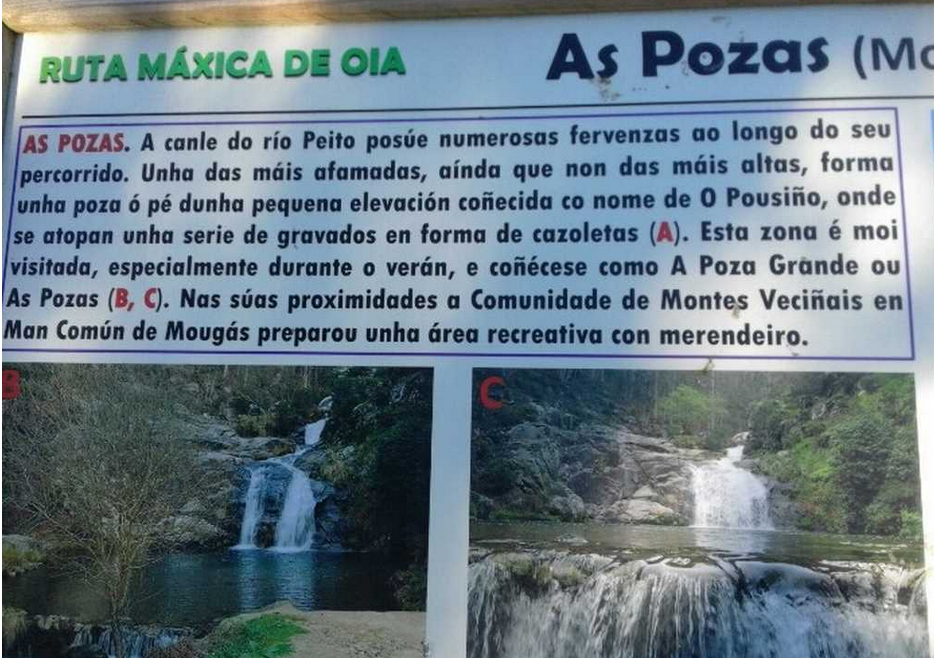 – The waterfalls of Ruta Maxica, on one of the informative panels along the route…
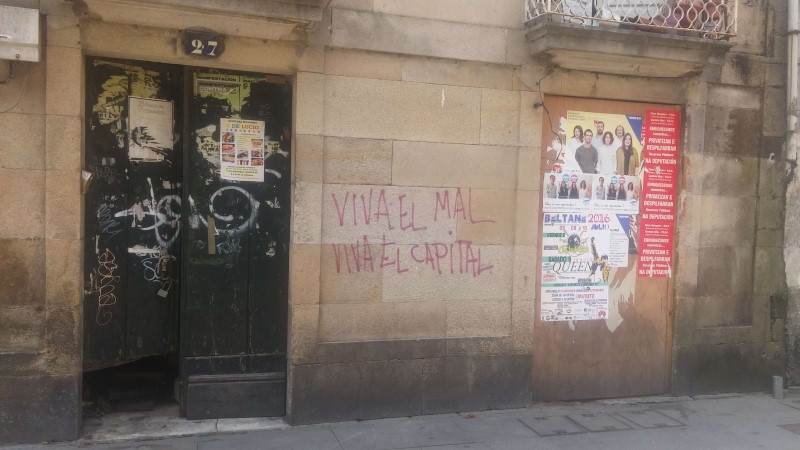 – Whether we like it or not, graffiti are present in almost every dark corner of and subterranean passage in Spain. Do they tell what locals think, or is it perhaps the opinion of the minority who sprays them?
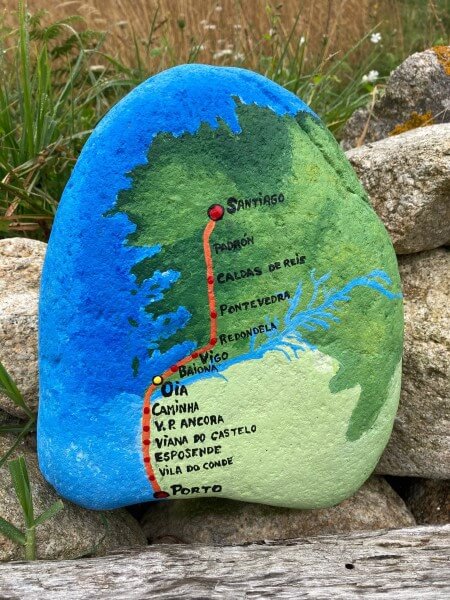
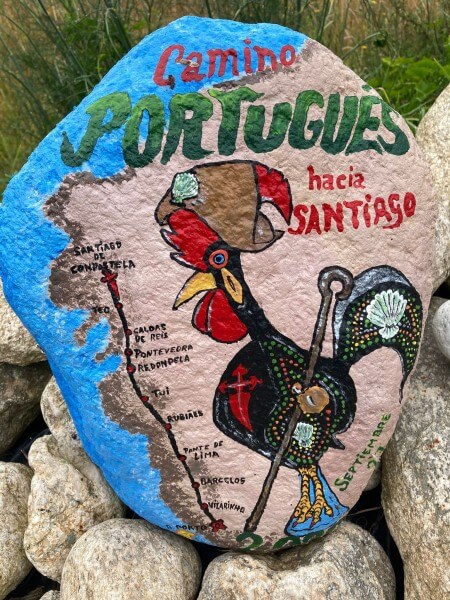 – Some people like to bring stones back from their journeys. And others like to bring ‘stones’ from their own country and leave them on the way. To which group do you belong?
Few tips at the end
- This is the last stage you spend away of the (in)famous last 100 kilometers of Camino Portuguese (that stretch starts more or less in Vigo). Things can get pretty crowded from Vigo, including the town itself. From now on I strongly suggest you to reserve the place to sleep, at least one day in advance, but ideally more. If you feel good and strong, and follow our guide, it will take you five more days to reach Santiago from Baiona. During the main pilgrim and tourist season (from early May to early mid October) it isn’t a bad idea checking accommodation options in Santiago already, and ideally book something there as well. You can for example check some great options I picked for you on Booking.com here.
Next/Previous Stage
- Next stage: Camino Portuguese de la Costa, Stage no. 7, Baiona – Vigo.
- Previous stage: Camino Portuguese de la Costa, Stage no. 5, Caminha – Oia.


![Ultralight Packing List for Camino de Santiago [2026 Edition]](https://caminolovers.com/wp-content/uploads/2022/03/altra-shoes-640-x-480.jpg)