Table of Contents
Basic Information
- Starting Point: Padron, Spain – A town deeply connected to the legend of Saint James, believed to be the place where his boat arrived after his martyrdom. With roughly 9,000 inhabitants, Padrón offers excellent services for pilgrims, including 7 pilgrim albergues, and plenty of other accommodation options. The town is also famous for its green peppers (“Pimientos de Padrón”).
- Ending Point: Santiago de Compostela, Spain – The spiritual and symbolic end of the Camino, home to the magnificent Cathedral of Santiago and the tomb of Saint James. All kinds of services, dozens of pilgrim hostels and hostels, and plenty of other accommodation options.
- Availability of an alternative route: Not really. Although it would be tempting to follow some alternative route and avoid the crowds on this last stage, there isn’t really any viable option. Hence if you want to avoid the crowds, you should either start pretty early from Padron or pretty late :).
- Map of the stage: map.
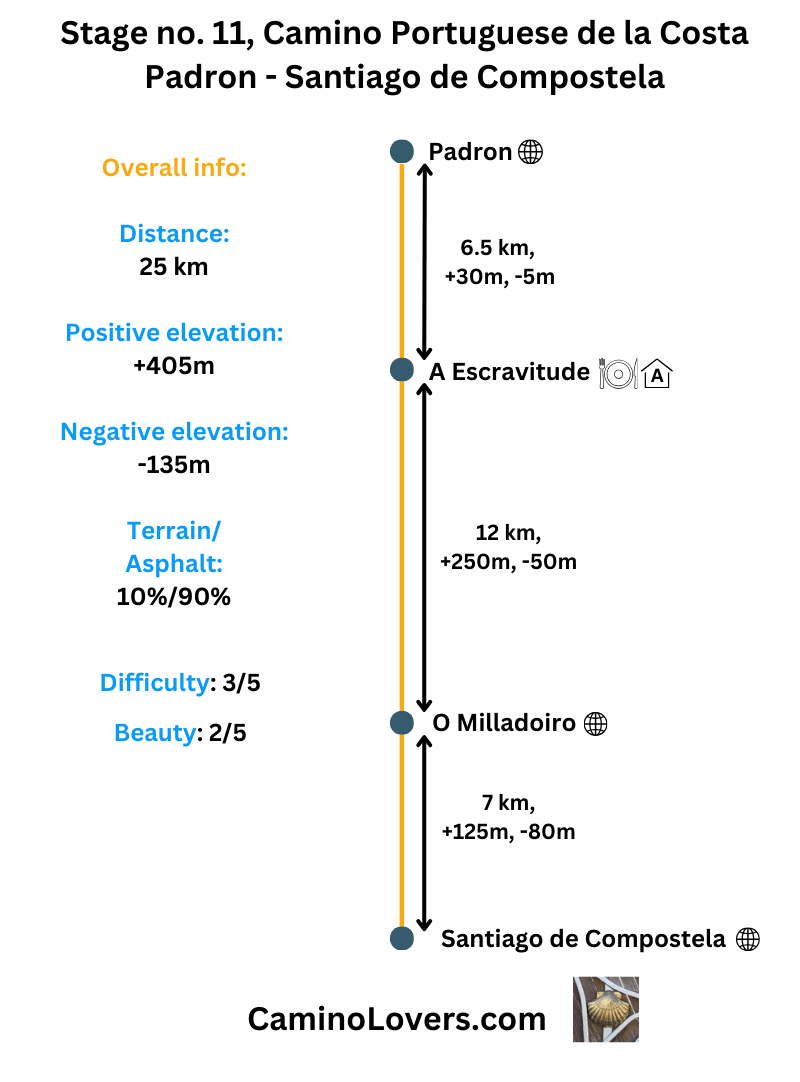
- Distance: 25 km (Download GPS here).
- Elevation Difference: +405m, – 135m
- Difficulty Score: 3/5.
- Beauty Score: 2/5 (lot of urban zone walking, but obviously reaching Santiago de Compostela is a highlight for every pilgrim).
- Terrain/Asphalt Walking Ratio: 10%/90%. Except of a few short stretches, it’s all on the road or right next to the road.
- Previous stage: Camino Portuguese de la Costa, Stage no. 10, Caldas de Reis – Padron.
Elevation profile for the route
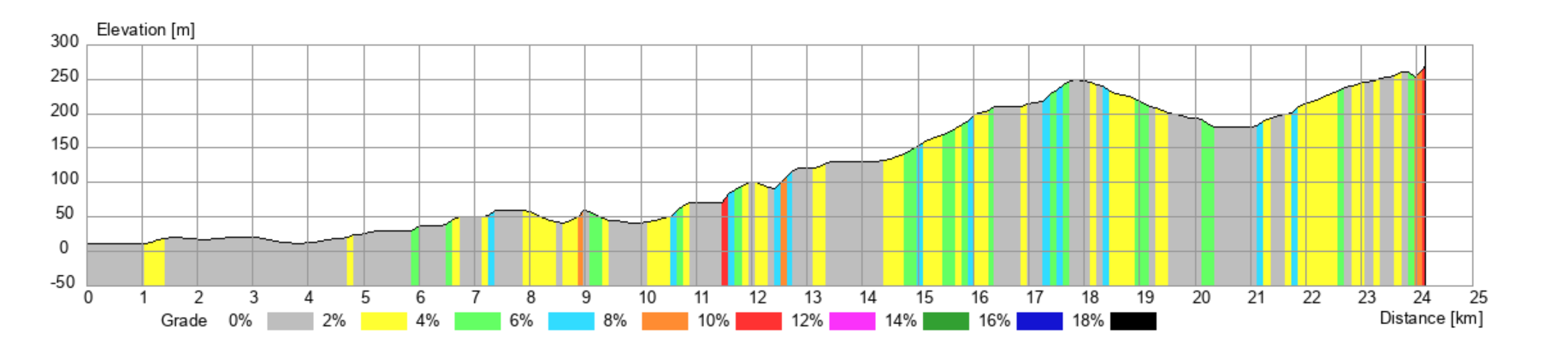
– The first 11 kilometers are pretty flat. From there on, it is almost a non-stop but pretty mild climb to Santiago, with one mild downhill between km 18 and 21. You have to suffer a bit on the last stage, and that’s exactly how it should be on any pilgrimage…
Advanced info about the stage
- Natural Highlights: Anything in particular worth mentioning. The last stage isn’t a complete letdown though, and especially in the first half you have some ‘forest’ sections and nice landscapes. But there isn’t any spot I would pick in particular for keeping your eyes on, or making a detour for.
- Historical & Cultural Highlights: Obviously the highlight is Santiago de Compostela. You will find everything in the city–many nice churches, museums, statues, art galleries, clubs with interesting concerts, and so on. For many pilgrims the biggest highlight is reaching the cathedral and attending a pilgrim mass there, with fellow pilgrims they’ve got to know along the way… However, I will recommend you a few places that aren’t that well known, and you won’t find them in tourist guides:
- The museum of magic: Extremely well done and an exposition you will remember for a long time. Let your senses get amazed by many demonstrations of the (apparent) breach of laws of physics and nature.
- Parque de la Alameda: The nicest park of Santiago de Compostela, close to the city center and to everything else. It is big enough and with enough hidden corners that you can find there a nice peaceful place of reflection after completing your long journey to Santiago.
- Mercado de Abastos: Local produce, fruits, veggies, meats, sweets, fish, flowers, craft work. considered by many as one of the best open markets in the entire Spain, it is open every day except of Sunday. A good place to take a stroll and perhaps collect some authentic souvenirs (not the type of souvenirs made in China that most pilgrims buy in the souvenir shops in the heart of the city).
- Camping/Bivouac Options on the Stage: A few people know that there is an official organized camping site right in the town of Santiago, called Camping as Cancelas. It is in a green part of town, on the hill, about 20 minutes waking from the cathedral if you’re a fast walker :). You can check the location and reviews on Google maps here. You should be able to stay there in your tent for about 25 euro/night, electricity including. Obviously Santiago isn’t a place for wild-camping, and I discourage you from trying so. If you are really desperate, however, or simply do not find any place in town whatsoever, you can try your luck in natural park Monte Pedroso, here. It is far from ideal and due to proximity of big town there are always people around, but it would do for one night of emergency camping, in one of the forested sections of the mountain…
- Dog-Friendly Score: 2/5. The last stage to Santiago isn’t particularly dog friendly. It is almost entirely on tarmac, with just a few trail sections in-between, and of course the entrance to Santiago is simply as any entrance into a big town would be... horrible for dogs. Having said that, Santiago isn’t completely traditional anymore, and you’ll find these “pet friendly” cafes and hostels in town, just like in many other big Spanish towns nowadays. To pick two good options for a stay with a dog I would go either with Meiga Backpackers, or with Albergue Alda o Fogar. They aren’t the least expensive hostels in town, but you can still get there a bed much cheaper than in a hotel, and they’re both decent.
- Special Remarks:
- Due to the popularity of pilgrimage Santiago gets extremely crowded in summer, and I recommend you booking accommodation at least 3-4 days in advance. If you won’t do so, you can end up sleeping in a hotel on the edge of town for $100 a night. And that’s certainly not an ideal scenario for any pilgrim.
- Camino Portuguese ends in Santiago, but the Cathedral isn’t necessarily the end of your wanderings in Spain… If you still feel like walking, or perhaps have a few days left before your flight departure, you can continue walking to the “end of the world“, the Faro de Finisterre, which typically takes 3-4 days to reach, with bus options back to Santiago. We do not have a guide ready yet for this way (although I walked it on a couple of occasions), but it is well-known and you can ask fellow pilgrims or just Google for “Camino Finisterre” to find more information. You can also check other caminos in Spain, on our map of all pilgrimage routes in Spain. Thank you for following our guide up to this point, and if you’d like to add something (for example you discovered an interesting spot on the way that we do not mention), please write me to “matej[at]caminolovers[dot]com”. Thank you!

My picks for accommodation on this stage
- Albergue Villa Vieira, A Escravitude, km 6.5. Location and reviews on Google maps here. A new, modern, clean albergue with excellent installations. Nice garden with a small swimming pool, excellently equipped kitchen, smaller rooms (for 8 people max), great quality beds, buffet breakfast from 5am! The owners still have a lot of enthusiasm for their project,and also a lot of success no doubt :). 30 beds in 4 rooms, 25 euro/night with breakfast included. Considering all installations and proximity to Santiago, it is a great deal and a great option for those who want to have shorter last day (for example to arrive in Santiago in time for a pilgrim mass, with everything one has to do before, such as leaving their backpack in luggage deposit). Check-in from 3pm, recommended way of making a reservation: Booking.com, exactly here.
- Albergue Milladoiro, Milladoiro, km 18. Location and reviews on Google maps here. A big, modern, excellently equipped albergue 7 km before Santiago. For those who want to have one extra night on the way :). Excellent kitchen, beautiful luminous communal spaces, comfortable beds, nice people in charge. 62 beds in 3 big rooms, 17-19 euro/night. Check-in from noon. Recommended way of making a reservation: WhatsApp on +34 981 938 382, or Booking.com, exactly here.
- Albergue Seminario Menor, Santiago de Compostela (km 25). Location and reviews on Google maps here. Probably the most legendary pilgrim place in Santiago. A building of a former seminary, it offers both shared rooms and small private rooms (with shared bathrooms), for really affordable prices considering we are in Santiago already (starting from 22 euro). The place is perfectly organized, and has everything onsite (shop, restaurant (for breakfast), many machines for clothes washing, vending machines, well-equipped kitchen, etc). Definitely my pick when I stay in Santiago, if they have a free room. Check-in from 1:30 pm. Recommended way of making a reservation: phone call, +34 881 031 768, or booking.com.
- You have dozens of hotels and other private accommodation options, all around Santiago, and dozens of pilgrim hostels. The availability is very limited though, especially in high season (which, speaking quite frankly, is a long one in Santiago :)). Hence if you look for a private place below 100 euro/night/room, you’ll have to be quite flexible with the location, or book enough in advance. You can explore booking for some great available options for your stay.
Pictures from the stage
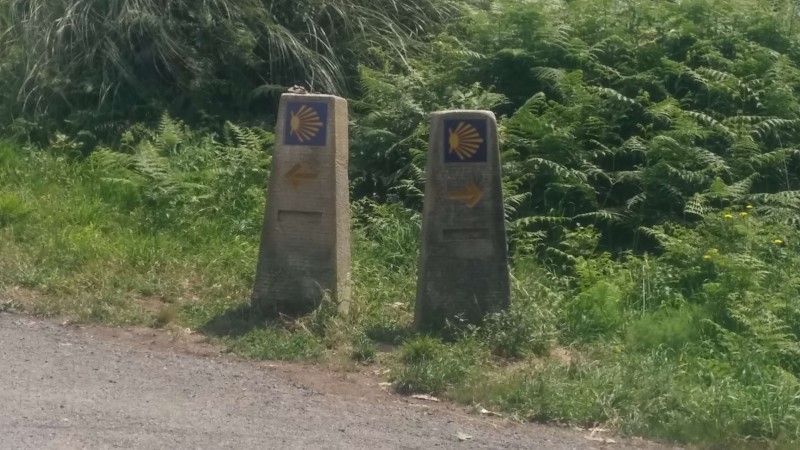 – Markers pointing in both direction, with the sign of kilometers left to Santiago missing. May seem like a mystery to an outsider. However, the simple explanation is that with the sheer number of people on the last 100 km, and plenty of souvenirs seekers among them, you’ll find many markers without some part.
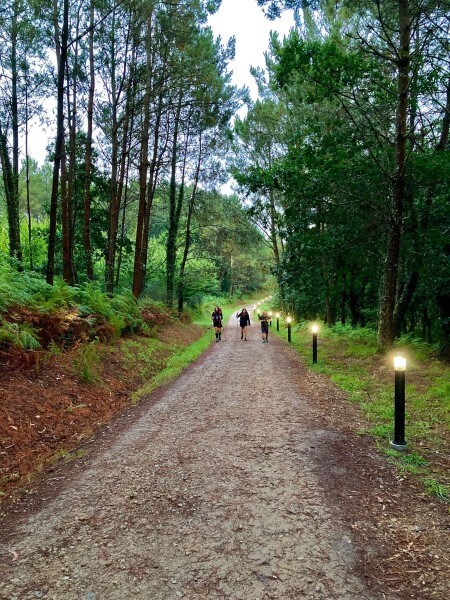 – Lighted last kilometers to Santiago
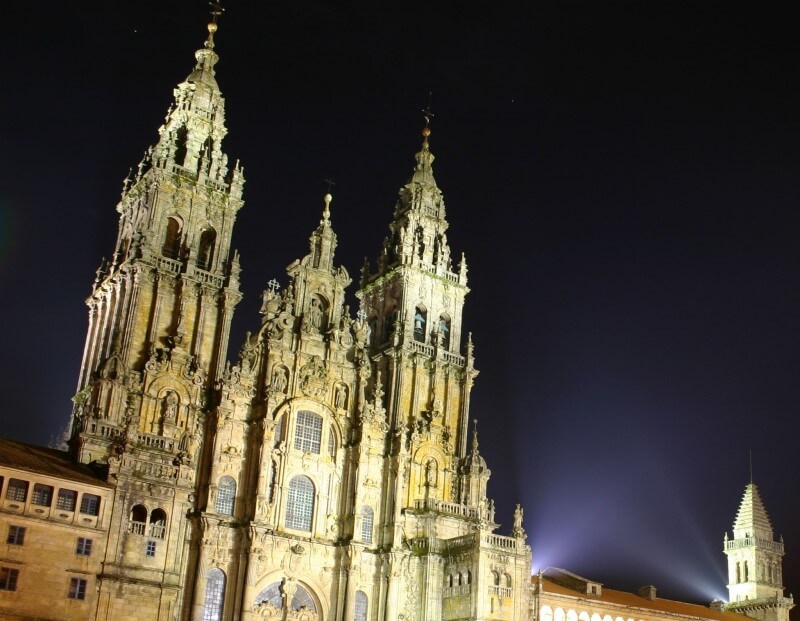 – The Santiago Cathedral at night. I’ve been here many times but still, certain places never lose their charm for a pilgrim…
Few tips at the end
- If you want to have a dinner with fellow pilgrims, in one of the restaurants in town, make sure to call and reserve the table in advance. Santiago is super busy all the way from April to October (because many tourists go there too…), and finding a free table for two, let alone five or ten, is close to impossible in the evening, almost in any restaurant in town. The same is true for accommodation. You should not rely on finding a bed just arriving to town. If you do so, you will either pay an outrageous sum of money, or spend hours going from one hostel to another, seeing that they are all fully booked. Book in advance and enjoy your arrival without worries.
Next/Previous Stage
- Previous stage: Camino Portuguese de la Costa, Stage no. 10, Caldas de Reis – Padron.



![Ultralight Packing List for Camino de Santiago [2026 Edition]](https://caminolovers.com/wp-content/uploads/2022/03/altra-shoes-640-x-480.jpg)